Buy.com Monthly Coupon

Saturday, April 23, 2011

Muhammad Yunus knew seeking to enter politics in Bangladesh would receive ‘bruising response'

SALEEM SAMAD

Professor Muhammad Yunus, pioneer of microfinance seems to have been aware of the risks and consequences of a political ambition he made after the military takeover in 2007 in Bangladesh, an Indian newspaper wrote on Friday.

The Hindu newspaper quoting The Indian Cables accessed in Wikileaks, the whistleblower internet-based news hub said Nobel laureate Yunus told Henry Jardine, the U.S. Consul General in Kolkata, India that he was aware of the “potentially bruising response” it would provoke from the ‘two ladies' [Sheikh Hasina, the current Prime Minister, and Khaleda Zia, former Prime Minister] and other established political figures.”

Understanding that Yunus strong interest to join the political fray, Manoj Mohanka, president of the Calcutta Chamber of Commerce (CCC), raised few questions about the “messy world” of Bangladesh politics and the “likelihood of Yunus reputation being tarnished.” Yunus responded and said that “he understood the dangers,” but “felt that responsible people had to step into the political field to make a real change in Bangladesh, which was wracked by corruption and poor governance.”

When US diplomat raised questions about rising Islamic radicalism, Yunus explained that “Muslim fundamentalists are a fringe not accepted by the Bangladeshi mainstream.”

In March 2011, the Bangladesh Central Bank removed Prof. Yunus as the Managing Director of Grameen Bank he founded, holding that he was 70 years old, well past retirement age. His appeals against the order were rejected by the courts, including finally by the Supreme Court.

A cable (96421: unclassified) sent on February 13, 2007 from the U.S. Consulate in Kolkata documented in detail the conversation between Jardine and Yunus when the latter visited Kolkata to participate in certain programs. During a conversation over lunch, which was hosted by the CCC, Jardine enquired about Yunus political ambition.

Yunus bitterly criticized Awami League [the ruling political party led by Sheikh Hasina], a primary advocate of a socialist, secular nation, had signed an agreement with fundamentalist group Bangladesh Khelafat Majlish ”to “recognize fatwas (religious edits) issued by Imams and block the introduction of laws contrary to Sharia law.”

Yunus in response to Consul General explains that it was “a reflection of the Awami League’s moral bankruptcy and was based on pure political calculus to garner a few additional votes and another example of the need for a new political party.”

The founder of Grameen Bank was receptive to the idea of Bangladesh expanding economic relations with India. However, he was concerned “that often it became a divisive political issue, with Bangladeshi politicians stoking resentment against India for political gain.” He was also quick to point out that all was not well with the Indian government too, “particularly the significant non-tariff barriers that restricted Bangladeshi goods from reaching Indian markets.”

Grameen Bank founded in 1976 empowered nearly 10 million poverty stricken population, mostly women, who received modest banks loans. Prof Yunus and the Grameen Bank together were awarded the coveted Nobel Peace Price in 2006.

Describing his mind, he narrated to the U.S. diplomat, included the opening of the Chittagong port to regional trade with India, Burma, Bhutan and China, and “the possibility of financing a new ‘mega-port' project in Chittagong to meet the regional demand” through the Grameen Bank.

The cable concluded after documenting Yunus views, and said he was “a person of great moral stature and strong organizational skills” and that his candidacy “could offer a possible out from the present Hasina-Khaleda a zero-sum game that cripples Bangladesh's democratic process.” [ENDS]

Saleem Samad, an Ashoka Fellow is an award winning investigative journalist based in Bangladesh. He specializes in Jihad, forced migration, good governance and politics. He has recently returned from exile after living in Canada for six years. He could be reached at saleemsamad@hotmail.com

Wednesday, April 20, 2011

Vitamin A enriched rice in five years to defeat deficiency

SALEEM SAMAD

AGRICULTURE SCIENTISTS in Bangladesh have plans to develop genetically-engineered Vitamin-A enriched rice variety in five years.

A genetically modified variety, the Golden Rice will go through greenhouse and field tests before advancing into production phase, like cultivation and harvest.

Unlike other poor countries, pregnant women and school children in Bangladesh suffer from preventable diseases which could be conquered by Vitamin-A supplements through most consumed food item.

Vitamin-A deficiency is a major cause of preventable blindness in children in Bangladesh. It also impairs growth, lowers resistance to infections and increases the risk of dying. In pregnant and postpartum women, Vitamin-A deficiency can have serious consequences for the health and survival of women and for the Vitamin-A status of their children.

In another front, government is expecting to fortify 300,000 metric tons of edible oil sold in retail markets. The initiative will ensure to reach remote villages, where Vitamin-A capsules is difficult to distribute.

"This week we are applying for permission to import the beta carotene-rich BRRI Dhan-29 from the IRRI experiment field and make a greenhouse trial at BRRI prior to going for open field trial in Bangladesh," Dr Alamgir Hossain, principal plant breeder at Bangladesh Rice Research Institute (BRRI) told independent English newspaper Daily Star.

Dr Hossain told The Daily Star on Saturday that once released commercially, consumption of only 150 gram of Golden Rice a day will supply half of the recommended daily allowance (RDA) of vitamin A for an adult. This is expected to revolutionize fighting Vitamin-A deficiency in the mostly rice-eating Asian countries where the poor have limited access to vitamin A sources other than rice.

Seattle-based Bill and Melinda Gates Foundation on April 13 provided a grant of over $10 million to IRRI to develop and evaluate Golden Rice varieties for Bangladesh and the Philippines. It is expected that the Golden Rice variety of BRRI Dhan-29 will be ready for regulatory approval by 2015.

HKI Vice President and Regional Director for Asia-Pacific Nancy Haselow says, “The most vulnerable children and women in hard-to-reach areas are often missed by existing interventions that can improve Vitamin A status, including Vitamin A supplementation, food fortification, dietary diversification, and promotion of optimal breast-feeding.” [ENDS]

Saleem Samad, an Ashoka Fellow is an award winning investigative journalist based in Bangladesh. He specializes in Jihad, forced migration, good governance and politics. He has recently returned from exile after living in Canada for six years. He could be reached at saleemsamad@hotmail.com

Monday, April 18, 2011

Rights bodies worried over abductions, extra-judicial killings

SALEEM SAMAD

Bangladesh rights groups are worried over scores of abductions by plainclothes security agents and extra-judicial killings.

Rights groups have documented the whereabouts of 22 people were alleged, picked up by anti-crime squads last year and are still unknown, according to a study by Ain-O-Salish Kendra (ASK).

The high court on July 19, 2010 directed the chief of police to investigate the case of missing Chowdhury Alam, a city councilor, who is one among those who have been abducted. He was abducted from the capital Dhaka.

The police chief has repeatedly denied of politician’s abduction and detaining him an in unknown place. However, police did not take any effort to find the person who is missing since June 19 last year. His family is worried about his safety and security of the family members too.

Sultana Kamal, a social justice activist and chairman of the rights group ASK, said on Monday, "Such allegations against law enforcers is worrying," she told English language The Independent.

Recently Mufti Fazlul Haque Amini, a leader of Islamic clerics at a press conference charged the government for abducting his youngest son Abul Hasanat who is missing since April 10. Police is yet to trace the person, not took effort to find him.

The Islamist in anger threatened the government to paralyze the country, if his son does not return home soon.

Two years ago the elite anti-crime Rapid Action Battalion allegedly picked up expelled Jubo League, youth organization leader Liakat Hossain, who was listed as most wanted criminal, from Dhanmondi residential area. His family is yet to hear the fate of Hossain. The authorities have not heeded to repeated appeal of his wife.

Adilur Rahman Khan, General Secretary of rights watchdog Odhikar "If such a situation prevails, the scenario of human rights in the country could worsen." [ENDS]

Saleem Samad, an Ashoka Fellow is an award winning investigative journalist based in Bangladesh. He specializes in Jihad, forced migration, good governance and politics. He has recently returned from exile after living in Canada for six years. He could be reached at saleemsamad@hotmail.com

Sunday, April 17, 2011

Four killed, scores hurt in worst ethnic clash in Bangladesh hills


Photo: Bangalee settlers torch indigenous homes in Manikchari on April 17, 2011
 SALEEM SAMAD

IN A worst ethnic riot four Bangla-speaking settlers were killed and 50 others injured over land grabbing at Ramgarh upazila, south-west Bangladesh on Sunday.

According to official sources, the four deceased were Bangla-speaking Muslim settlers from land hungry floodplains and some of the injured were admitted to government health centre in "critical condition".

The civil administration imposed a ban on movement and assembly of more than three persons in the riot-torn area. Large contingent of law enforcing officers are patrolling the region to maintain peace.

The worst riot in a year began in the afternoon and continued for nearly three hours, before riot police and para-military forces pacified the rivals.

Independent newspapers Daily Star correspondent who could be reached over mobile phone and identified as Cippru Marma, an indigenous of the area said, the incident took place as settlers wanted to grab their ancestral lands and were planting banana trees.

Local administration official also said that at least 20 houses of the Buddhist ethnic people were torched in reprisals for the killings.

Dispute over land ownership is one of the major causes of conflict between Bangalees and the ethnic groups in the hill-forest area, a home to at least 15 ethnic communities.

The plain land settlers allegedly occupied lands which belonged to the ethnic minorities during the two decade-long insurgency from mid-1970s to late 1990s.

The insurgency came to an end through signing of a 1997 treaty between the government and the ethnic groups. [ENDS]

Saleem Samad, an Ashoka Fellow is an award winning investigative journalist based in Bangladesh. He specializes in Jihad, forced migration, good governance and politics. He has recently returned from exile after living in Canada for six years. He could be reached at saleemsamad@hotmail.com

Islamic zealots threatens to paralyze Bangladesh

SALEEM SAMAD

AN ISLAMIST leader threatened on Friday that he could paralyze the country in an hour if his missing son does not return home at the soonest.

Recently the Islamists shutdown throughout the country on April 4 demanded of the government to scrap the women’s policy which advocates gender equality and education policy, which the Muslim zealot described both as anti-Islamic. The government rejected their claim.

Mufti Fazlul Haque Amini, leader of Islamic clerics said in the morning that he had no doubt that prime minister have knowledge of the disappearance of his son, Abul Hasanat, who has been missing since Sunday last.

Amini, chairman of faction of the Islami Oikya Jote (IOJ) claimed that plainclothes security agents kidnapped his youngest son in the capital Dhaka. However, the law enforcement agencies have vehemently denied it. Police is yet to trace the whereabouts of Hasanat.

Missing person’s elder brother Abul Farah described to an English daily last week that five to six people with weapons and walkie-talkies dragged his brother in a sports utility vehicle having tinted windows, leaving two witnesses who are his friends.

The Islamist party also a major alliance partner of the mainstream opposition warned while addressing a meeting of Muslim bigots at the National Press Club.

Amidst thunderous claps he spoke loudly that “if my son is not set free, I have the power to make the country paralyze within an hour.”

"We will not retreat from the campaign to implement Islamic Sharia law in the country, even if his family is intimidated, like they did to my son."

The Islamist vowed that no anti-Islamic groups would be allowed politicking secularism and western democracy to take charge of the state power. [ENDS]

Saleem Samad, an Ashoka Fellow is an award winning investigative journalist based in Bangladesh. He specializes in Jihad, forced migration, good governance and politics. He has recently returned from exile after living in Canada for six years. He could be reached at saleemsamad@hotmail.com

Thursday, April 14, 2011

Bangladesh to legalize political Islam, ignoring courts decision to restore secularism

SALEEM SAMAD

DESPITE ELECTORAL promise and apex court’s ruling to restore secularism, the Bangladesh parliament is poised to bring an amendment to establish Islam as state religion and legalize religious politics.

The Sunni Muslim majority nation of 158 million will relax stringent restrictions imposed in the constitution of 1972.

The constitutional amendment committee members said in “prevailing political reality” the parliamentary special committee on constitutional amendments on Monday decided to advocate for relaxing restrictions on political Islam so that Islamic parties can continue functioning without any restrictions.

The provision of Article 38 of the Bangladesh constitution bans use of religion for political purposes. Instead, the article allows every citizen to form associations or unions, subject to any reasonable restrictions imposed by law in the interest of morality or public order.

Prime Minister Sheikh Hasina, leader of the ruling Awami League, at Monday’s meeting said the ruling party would not curb the political rights of Islamist parties. The secularist activists expressed there frustration and women rights groups are disgusted after recently hearing prime minister's political vision to keep Islam as state religion in the constitution.

The Awami League government in 1972 banned religion-based organizations after Islamic parties collaborated with the marauding Pakistani army that killed 3 million people in nine months in 1971.

Hasina, also the leader of the House, made it clear to the committee that her government would keep “Bismillah’ir Rahman’ir Rahim” (Faith in Allah) in the preamble of the constitution and retain Islam as the state religion.

Two previous military rulers, Gens. Ziaur Rahman and H.M. Ershad deliberately doctored the constitution to keep the Islamists in good humor. In 1978, the provisions of article 38, prohibiting communal bodies, were dropped while in 1988 Islam became the state religion.

The dreaded Islamist party Jamaat-e-Islami, whose leaders are now facing war crime charges, became politically active following the 1978 order.

Earlier in July last year the apex court, in a landmark judgment banned political parties that propagate Islamic ideology, reverting to the original constitution of 38 years ago.

Moments after the judgment the rights groups seems to be excited by the court’s verdict and interpreted that it was a major blow to the Islamist parties which foresees Sharia law for apparently a secular Muslim population and also advocates Koran and Sunnah which will eclipse the state constitution.

"It seems that the government is reading a wrong message from the secularists and liberal Muslims," remarked Shahriar Kabir, a researcher on Muslim radicalism and extremism.

A secularist advocate, Shahriar Kabir, said the prime minister’s statement has confused the nation and it seriously contradicts the verdict of the superior court. It seems that the war criminals and their adversaries have nothing to fear. Their parties would continue to function and overtly work against the war crimes trial, he remarked. [ENDS]

Saleem Samad, an Ashoka Fellow is an award winning investigative journalist based in Bangladesh. He specializes in Jihad, forced migration, good governance and politics. He has recently returned from exile after living in Canada for six years. He could be reached at saleemsamad@hotmail.com

Monday, April 11, 2011

Bangladesh bans mobile phone use by school teachers

Photo: Getty Images/Shakira sits with children at a Bangladesh primary school


SALEEM SAMAD

BANGLADESH AUTHORITIES imposed a ban on use of mobile phones use by school teachers in class rooms.

In one of the best practices, the disadvantaged children’s organized Child Parliament in a study in 2010 found that 75 percent of the school teachers speak on the phone, suspending lessons of their students. Similarly a year before it was one percent less.

Nurul Islam Nahid, education minister announced on Sunday at the 8th Child Parliament session held in the capital Dhaka.

Child Parliament organized by Save the Children Australia, Manusher Jonno Foundation and Plan International, is a platform where disadvantaged children discuss their rights and advocacy with policy makers and voice their agenda.

Nahid lamented that his earlier warning was ignored, but said he would issue a rule which would become an official guideline. He believes that the new rule would act as deterrent for the disobedient teachers.

He warned that the teachers would be punished for negligence of duties to impart lessons in schools. [ENDS]

Saleem Samad, an Ashoka Fellow is an award winning investigative journalist based in Bangladesh. He specializes in Jihad, forced migration, good governance and politics. He has recently returned from exile after living in Canada for six years. He could be reached at saleemsamad@hotmail.com

Sunday, April 10, 2011

NASA to study vulnerability of largest mangrove forest in Bangladesh

SALEEM SAMAD

IN THE wake of climate change, acclaimed space science agency the National Aeronautic and Space Administration (NASA) has decided to fund a study on the changes of the mangrove forests and its overall effect on the entire ecosystem.

NASA awarded $637,000 to a Bangladesh-born scientist Faiz Rahman, a professor of Indiana University in Bloomington to conduct a study on the vulnerability of the Sundarbans, recurrently lashed by cyclones and tidal surges.

Rahman, presently living in Indiana State discussed his plan while talking to private wire service banglanews.com and said the project is scheduled to begin from August 2011.

The Bangladeshi scientist has been designated as principal investigator of the project. Three other investigators are – Dr. Rinku Roy Chowdhury, an assistant professor of geography Department of Indiana University, and Dr. Boone Kauffman and Dr. Daniel Donato of the US Forest Service.

Sundarbans, the world’s largest mangrove forest which is shared by two countries – Bangladesh and partially India is the home of 2,000 magnificent Bengal Tigers.

Recently Bangladesh has decided to use radio collars to track and monitor the ferocious Bengal Tigers, said Dr Mohammad Anwarul Islam, chief executive of Wildlife Trust of Bangladesh.

The investigating team of Rahman will study the largest mangrove forests over the next three years to identify the reasons behind the ongoing changes occurring in the forests, its capacity for carbon absorption and other factors contributing to bringing the change in the forests—its flora and fauna.

The program was undertaken as part of the U.S. government’s Carbon Cycle Science Program, a partnership of several governmental agencies, including the U.S. Dept. of Commerce, the Dept. of Energy, the Dept. of Agriculture and U.S Natural Science Foundation and NASA and others.

Explaining the importance of the Sundarbans to Bangladesh, Rahman said, “Some 6000 people died in cyclone ‘Aila’ in 2007. Another cyclone named ‘Nargis’ hit Myanmar the following year, leaving more than 100,000 people dead, and the damages from the cyclone were immense.”

“The Sundarbans is the single-largest block of mangrove forests in the world, covering nearly 10,000 square kilometers (3,861 sq miles) of the Bay of Bengal delta. The mangrove trees play a significant role in absorbing carbon from the atmosphere, but the extent of the carbon sink,” said Rahman.

Regarding the planned study, Rahman categorically said that the research would not only focus on collecting information about forest density and carbon stocks but also investigate the damage done by human beings in the forests and, consequently, socioeconomic impacts on the life of Bangladeshi people.

Meanwhile, Bangladesh plans to launch its own communications satellite within a year, Post and Telecommunications Minister Raziuddin Ahmed Raju disclosed to journalists on Sunday. The cost of the program will be between $150 million and $200 million.

The satellite would serve commercial purposes including improving telecom services, helping to meet the booming demand for it. In addition television broadcasting and meteorological data including disaster warnings would be available from the satellite. The satellite would also help mapping natural resources, and to predict weather to help farmers, an expert said.

Bangladesh’s neighbors India and Pakistan launched their own satellites in 1980 and 1990 respectively. [ENDS]

Saleem Samad, an Ashoka Fellow is an award winning investigative journalist based in Bangladesh. He specializes in Jihad, forced migration, good governance and politics. He has recently returned from exile after living in Canada for six years. He could be reached at saleemsamad@hotmail.com

Friday, April 08, 2011

After repatriation from troubled Libya, rehabilitation remains a major challenge

SALEEM SAMAD

Bangladesh with assistance from international organizations has been able to repatriate overwhelming majority of migrant workers from strife torn Libya. The biggest challenge up front is rehabilitation, reintegration into the society.

The International Organization of Migration (IOM), with the support of United Nations refugee agency UNHCR and Bangladesh government, more than 30 thousand Bangladeshis living and working in Libya have returned to Bangladesh.

In one month starting from 01 March, IOM assisted the return of 28,329 Bangladeshis in 92 IOM chartered flights and 11 Bangladesh Biman flights while approximately 3,433 came back self-arranged or arranged by their employers, an IOM statement issued on Thursday from Bangladesh office stated.

The UN Secretary General Mr. Ban Ki-moon had said recently that with such swift, efficient and large evacuation of third country nationals, a major humanitarian disaster have been averted so far.

“About 200 Bangladeshis remain at the different borders with Libya today, with an average of 120 new arrivals every day. An estimated 30,000 Bangladeshis still remain inside Libya. If land travel situation improve, it is likely that another surge of thousands of Bangladeshis may flee to the borders, needing evacuation. The government and IOM would urgently need to be prepared for that’, said Rabab Fatima, Regional Representative of IOM in Dhaka, Bangladesh.

Meanwhile, the government fears that foreign remittance inflow is likely to fall, which is more than seven million immigrants and migrants contribute nearly 10 billion in the national economy. Foreign remittance by migrant workers and immigrants is the highest single foreign currency income.

However, the political crisis in Libya, Yemen, Syria, Tunisia and Egypt in the Gulf region will further cause insecurity, fear and instability which will result in further abandoning their place of duty due to negative economic scenario, said Dr. Tasneem Siddique, president of Refugee and Migratory Movement Research Unit.

Bangladesh authority has launched diplomatic maneuvers to persuade Japan, Saudi Arabia and other countries to offer jobs to skilled workers returning from Libya and other troubled Gulf states. Japan is engaged in massive rehabilitation program after Tsunami coupled with severe earthquake last month completely damaged most of the northern region and needs thousands of construction workers.

“The crisis is far from over. More than ever, we appeal to donors to maintain stamina. We are in this for the long haul and we have to collectively ensure that the plight of those fleeing the violence in Libya is not prolonged due to a lack of funds,” states IOM Director General William Lacy Swing. [ENDS]

Saleem Samad, an Ashoka Fellow is an award winning investigative journalist based in Bangladesh. He specializes in Jihad, forced migration, good governance and politics. He has recently returned from exile after living in Canada for six years. He could be reached at saleemsamad@hotmail.com

Wednesday, April 06, 2011

Bitter battle of microcredit celebrity likely to strain US-Bangladesh ties

SALEEM SAMAD
A SENIOR United States official once again warned that its bitter battle between Muhammad Yunus and the Bangladesh authority could dent diplomatic ties between two countries.

US Assistant Secretary of State for South and Central Asian Affairs Robert O Blake warned that failure to find a compromise that respects Dr Yunus’ global stature and maintains the integrity and effectiveness of Grameen Bank “could affect our bilateral relations.”

The apex court on Monday confirmed the High Court ruling that backed the sacking of the Nobel Peace laureate from Grameen Bank as its managing director.

Nobel laureate Professor Muhammad Yunus unceremonious exit from the bank he founded for having no legal authority to act as the micro-lender's managing director, since its board had not obtained the Bangladesh Bank's sanction to re-appoint him beyond the bank's official retirement age of 60.

A day later Blake made the remark on Tuesday in his testimony before the House Foreign Affairs Committee in Washington, reports private wire service United News of Bangladesh.

The US Secretary of State Hillary Clinton is a close friend of Yunus, who has won the two highest civilian honors of the US — American Presidential Medal of Freedom and Congressional Gold Medal.

Last month in Dhaka, Blake issued a thinly-veiled threat that if a compromise was not reached at on the Yunus issue, the US-Bangladesh relationship would get 'impacted', writes news agency bdnews24.com.

“Dr. James Wolfensohn and I pressed the government of Bangladesh to protect the integrity of civil society and the autonomy of the Grameen Bank, and I warned that a failure to find a compromise that respects Dr. Yunus’ global stature and maintains the integrity and effectiveness of Grameen could affect our bilateral relations,” Blake told the Congressional Committee.

Finance Minister AMA Muhith last month said the government would be open to some compromise – such as to allow Yunus to remain an emeritus fellow at Grameen – but not, however, to his proposal that he should step aside as managing director and be made chairman instead.

As a democratic and moderate Sunni Muslim majority nation of 165 million people, the US State Department official said Bangladesh is a country with which the United States has a vested interest in maintaining close relations.

Blake said Bangladesh is a secular democracy, with a history of religious and ethnic tolerance. It also can be proud of its vibrant and innovative civil society, which has produced such outstanding global citizens as microcredit celebrity Muhammad Yunus, who’s Grameen Bank, was a pioneer of the concept of “microcredit” - providing small loans to tens of millions of Bangladeshis, especially women, who possess little or no collateral.

Despite success in economic growth and outmatched US trade with Bangladesh in recent years, but he said country still remains among the poorest countries in Asia. [ENDS]

Saleem Samad, an Ashoka Fellow is an award winning investigative journalist based in Bangladesh. He specializes in Jihad, forced migration, good governance and politics. He has recently returned from exile after living in Canada for six years. He could be reached at saleemsamad@hotmail.com

Monday, April 04, 2011

Mullahs in Bangladesh clashed with police protesting gender equality of women

Photo: Nashirul Islam/ bdnews24.com/ Activists of Islamic Law Implementation Committee block Dhaka-Chittagong highway at Signboard area of Narayanganj on Monday during the countrywide general strike

SALEEM SAMAD

ISLAMIC BIGOTS along with students of Koranic schools in Bangladesh clashed with riot police on Monday while enforcing country-wide shut down protesting government’s decision of gender equality of women, which zealots interpret as anti-Islamic.

Police said the day-long shut down turned violent when the Islamists and students sporting Koran and shroud, were armed with welding sticks, rocks and home-made bombs clashed with riot police in many towns and cities of Bangladesh.

The clashes with law enforcers left nearly 250 injured and another 500 activists detained.

Striking Islamic bigots supported by Islamist students went on a rampage and vandalized more than a hundred buses carrying hundreds of Muslim devotees in Chittagong and Khulna cities, blocked highway’s main artery between the capital Dhaka with the eastern region for several hours.

Even the lawmakers came under attack. The activists stormed the vehicles carrying them separately in two towns, east of the capital. Lawmakers Mohiuddin Khan Alamgir and RMA Obaidul Muktadir Chowdhury, however, escaped unhurt.

Ruling Awami League general secretary and Minister Syed Ashraful Islam on Monday termed the strike enforced by an Islamic coalition as ‘politically’ motivated. The ruling-party leader instead blamed opposition alliance for instigating the Islamist.

Minister for Religious Affairs Mohammad Shahjahan on the eve of the nation-wide strike by Muslim zealots termed Bangladesh as a secular country where people have been enjoying equal rights irrespective of their caste, creed and religion. He challenged the Islamist leaders into a debate to prove that the policy contradicts to the principles of Koran.

Further he said the women development policy envisages equal opportunities for women and their share in property, employment and trading for all religion including Hindu, Christian, and Buddhist.

Islamist parties including Jamaat-e-Islami have long been protesting the policy which mentions gender equality.

Slamming the government for arresting anti-women policy supporters, Mufti Fazlul Haque Amini, chairman of a faction of Islamic Oikkya Jote (United Islamic Alliance) on Monday warned of a tougher anti-government agitation unless the arrestees are freed within 24 hours deadline.

Amini, leader of Islamic Law Implementation Committee which called for the country-wide shut down told journalist that the “strike was a perfect reply against the government’s anti-Islamic policy like High Court banning of Fatwa (Islamic edict), National Education Policy, and National Women Development Policy 2011,” he said.

Police detectives raided a Koranic school in Brahmanbaria, founded by striking leader Amini, and recovered five home-made bombs and detained eight students.

Earlier on eve of the shut down, the Muslim chauvinist Amini, also major partner of the opposition alliance threatened non-stop shut down if the government resisted the strike, called to protest the proposed National Women Development Policy 2011, which recommends for gender equality and equal share by women in parental properties.

The Islamist leader also announced countrywide agitation programme which begins from Apr 5 until May 27.

He cautioned that nobody will remain in state power of this country after taking position against Koran and Sharia. Responding to a query regarding ongoing hearing on the banning of Fatwa in the apex court, he said: “The whole country will be on fire if the court verdict goes against Fatwa.”

Leader of the opposition Begum Khaleda Zia who returned from a pilgrimage to Saudi Arabia on the eve of the strike called by her alliance partner United Islamic Alliance, cautioned the government not do anything that might hurt the religious sentiment of the people and create chaos. It needs time and it would not be wise to do something by applying force, she observed.

Khaleda Zia who was twice prime minister of the country is apprehensive that any move hurting religious sentiments may lead to anarchy in the country. She, however, lauded that Bangladesh has made significant progress in women's development. [ENDS]

Saleem Samad, an Ashoka Fellow is an award winning investigative journalist based in Bangladesh. He specializes in Jihad, forced migration, good governance and politics. He has recently returned from exile after living in Canada for six years. He could be reached at saleemsamad@hotmail.com

Friday, April 01, 2011

Bangladesh probe into “Tiger” in world cup debacle

Photo: Bangladesh's captain Shakib Al Hasan bowls during their fifth one-day international cricket match in Dhaka
SALEEM SAMAD

THE GOVERNMENT will look into causes behind humiliating defeats to take necessary measures to overcome the weaknesses

Millions of “Tiger” fans are excited that official investigation has been launched into the Bangladesh cricket team's failures at the World Cup cricket on Friday.

The Bangladeshi team dubbed as “Tiger” came in for strong criticism after they were bundled out for just 58 runs by the West Indies. Later, South Africa bowled them out for just 78. It meant they narrowly missed out on a spot in the quarter-finals.

“A probe team will be formed to find the cause of our players’ failure,” Bangladesh state minister for sports, Ahad Ali Sarkar told scribes.

"We are trying to find the causes behind these humiliating defeats. We shall take necessary measures to overcome these weaknesses," Sarkar said.


"We will certainly investigate into the reasons behind the debacle. We also want to see the Bangladesh Cricket Board to be more transparent and accountable," Sarkar said.

However, a Bangladeshi Cricket Board official does not agree with the sport minister’s decision for a probe. Manzur Ahmed, chief executive officer of the Bangladesh Cricket Board argued that “success and failures are part of any sport.”

The “Tigers” defeat by West Indies sparked angry reactions among fans who stoned a bus carrying the West Indies team presuming to be Bangladesh cricket team. Security had been beefed up to ensure adequate safety of the visiting cricket teams shuttling from hotels to stadium.


The team managed to beat England but was trounced by the West Indies and also lost to South Africa and India in their first round matches.

Bangladesh is one of the co-hosts of the 2011 Cricket World Cup and hosted eight matches. The other hosts, India and Sri Lanka incidentally will play final in Mumbai, India on (tomorrow) Sunday.

The resource starved nation of 158 million had to divert other development budgets for setting priority on security for 14 participating World Cup Cricket teams arriving capital Dhaka.


Bangladesh prime minister Sheikh Hasina on March 2 told parliament that her government allocated USD 65.6 million (USD 1=BDT 72.60) for the mega Cricket World Cup event.

The financial resource starved nation had to divert USD 7 million shortfalls from other development budgets for priority on full-proof security for the Cricket World Cup, an official of the Sports Ministry said. [ENDS]

Saleem Samad, an Ashoka Fellow is an award winning investigative journalist based in Bangladesh. He specializes in Jihad, forced migration, good governance and politics. He has recently returned from exile after living in Canada for six years. He could be reached at saleemsamad@hotmail.com


Thursday, March 31, 2011

Bangladeshi doctors to face music for doctored autopsy report in flogging death

SALEEM SAMAD

FOUR BANGLADESH doctors in a government hospital will face music after probe committee found the post-mortem report of flogging death of Hena Begum was deliberately doctored.

A probe document submitted to the High Court on Thursday reveals that fifteen-year-old Begum of a sleepy town in west Bangladesh was raped by her 40-year-old cousin. Days later the village elders and Mullahs of the mosque ordered 101 lashes following a Fatwa (religious edict) in local arbitration on January 24.

Hena Akhter could not survive after 70 blows and collapsed. She was hospitalized but died a week later, and her death was judged a suicide by a local government hospital.

An independent English newspaper Daily Star in a first page article on February 7 raised doubts about the autopsy report from the small towns, which prompted the court to issue directives the same day for exhumation of Begum's body and a fresh autopsy.

An initial autopsy report cited no injuries and deemed her death a suicide. Begum's body was exhumed on orders from the High Court and a second autopsy concluded that she had died from wounds "of a homicidal nature" on her scalp, abdomen, back, chest, arms and legs.

The girl child’s death provoked widespread outrage in Bangladesh, where punishments in the name of Fatwa were outlawed last July.

The High Court asked the government to indict the doctors, including the civil surgeon of Shariatpur district, where Begum had lived, for preparing a "false post-mortem report to hide the real cause of her death."

The report stated that the doctors of Shariatpur General Hospital and district Civil Surgeon are “equally” guilty for deliberately not mentioning the injury marks on Begum's body. “The civil surgeon's negligence in preparing the autopsy report has been proved which is against medical ethics,” the report said.

Meanwhile, the police chief recommends departmental actions against two police officers who were accomplice of false investigation report.

"What sort of justice is this? My daughter has been beaten to death in the name of justice. If it had been a proper court then my daughter would not have died," Dorbesh Khan, Begum's father, reportedly said at the time. [ENDS]

Saleem Samad, an Ashoka Fellow is an award winning investigative journalist based in Bangladesh. He specializes in Jihad, forced migration, good governance and politics. He has recently returned from exile after living in Canada for six years. He could be reached at saleemsamad@hotmail.com

Wednesday, March 30, 2011

Government opts for respectable exit for Yunus, while global support pours

SALEEM SAMAD

AT THE time when Bangladesh government softened their reactive mood and have described that the ball is in Nobel laureate Professor Muhammad Yunus court, more global moral support pours in for the pioneer of banking the poor.

Two weeks ago a number of United States Senators and Congressman have expressed their concern over the humiliation faced by the international icon of microfinance.

A week ago Robert Blake, the visiting U.S. Assistant Secretary of State for South and Central Asian Affairs cautioned that if the Yunus issue remains unresolved, it will impact bilateral relations between Bangladesh and the United States.

The moral supports coincided with Bangladesh Supreme Court on Tuesday adjourned until April 4 the hearing on the petition filed by Muhammad Yunus seeking a stay order on the High Court judgment upholding his dismissal as the Grameen Bank managing director.

The central bank on March 2 removed the Nobel laureate from his position for allegedly flouting rules when he was reappointed in 1999. Yunus filed the petition against the order which the High Court had rejected earlier.

The unceremonious exit of Yunus has invited bricks and bouquets at home and globally. The government is embarrassed by blitzkrieg reaction from the press, politicians, celebrities and development practitioners.

Meantime a number of international microfinance organizations and civil society in Italy, Peru, Philippines and Pakistan have issued statements expressing support in solidarity with Prof. Yunus, founder of Grameen Bank.

Mario Baccini MP, President of the Italian Committee for Microcredit, Prof. Luisa Brunori of Bologna University, Sam Daley-Harris and European Member of Parliament Sylvia Cost said Prof Yunus with Grameen Bank have made significant mileage in social development in Bangladesh through microfinance. They are leading actors in the fight against poverty, writes private news agency United News of Bangladesh.

A statement of the Global Center for Development and Democracy (CGDD) and on behalf of President Alejando Toledo of Peru said “our organization, which cares about international development, has been following very closely the developments, and is very much concerned
about the progress which could be lost if the country’s leaders fail to appreciate what makes the Grameen Bank work.”

The statement further said that “If he (Toledo) becomes our next president, we expect to extend microloans to the poorest in our country in order to lift all Peruvians who are living below poverty conditions, out of it.”

Another letter to Prof Yunus from CARD MRI Family of Philippine said “our more than 1.5 million members and clients would like to assure you of our unwavering support to you as the Managing Director of Grameen Bank.”

An open letter from Kashf Foundation of Pakistan said Yunus and Grameen Bank are today global icons and torch-bearers for the mission to eradicate poverty, as well as to provide sustainable choices to poor households across the world.

It said the work of Grameen Bank has been replicated across 100 countries and has benefited over 170 million poor women globally. [ENDS]

Saleem Samad, an Ashoka Fellow is an award winning investigative journalist based in Bangladesh. He specializes in Jihad, forced migration, good governance and politics. He could be reached at saleemsamad@hotmail.com

Sexual abuse, exploitation of children in Bangladesh appalling

Lack of confidence of justice delivery system, sexual abuse and exploitation of children in Bangladesh skip prosecution

SALEEM SAMAD

CHILDREN IN Bangladesh are highly vulnerable to sexual abuse and exploitation, not only behind the closed doors of brothels but also in households, academic institutions and on the streets, revealed a UNICEF study on Tuesday.

Nearly 50 percent of the girls found engaged in prostitution had been sexually abused before joining the sex trade. The ‘slippery slope’ imagined from sexual abuse to prostitution to trafficking suggests a moral descent.

This study exposes the serious issue of sexual abuse of boys which has failed to be properly recognized in the past. Alarmingly, is that boys are becoming frequent clients of prostitutes.

Poverty-stricken Bangladesh boast of conservative culture, is an overwhelming Sunni Muslim majority where overtly speaking of sex is a social taboo.

The study made it clear that sexual abuse of children and their exploitation in prostitution derives from deep structural and societal problems coming from relationships between adults and children and how gender and sex are understood in a society of socio-economic inequality.

Most child sexual harassment cases in Bangladesh do not go for trial as the victims have no confidence in the justice delivery system. Efforts should be made to increase the number of prosecutions for sexual abuse of girls. Laws exist but the application is difficult, observed social anthropologist Therese Blanchet who conducted the study.

The study reveals that greater attention is given to ‘manage’ the dishonor and minimize social consequences while little support is offered to the traumatized person who is expected to silence her pain.

Despite the cultural limitation, the report recommends to introduce sex education in schools to prevent sexual abuse, stressed the need for strengthen employers’ responsibilities to prevent sexual abuse in the workplace.

Blanchet suggests that girls and adolescents engaged in prostitutions should be carefully looked at to improve ways to ‘recover’ and ‘reintegrate’ them back into the society.

UNICEF works for children's rights, their survival, development and protection calls for coordinated efforts to end both sexual abuse and commercial exploitation of children as child sexual abuse is widely ignored compared to commercial sexual exploitation and child trafficking. [ENDS]

Saleem Samad, an Ashoka Fellow is an award winning investigative journalist based in Bangladesh. He specializes in Jihad, forced migration, good governance and politics. He has recently returned from exile after living in Canada for six years. He could be reached at saleemsamad@hotmail.com

Tuesday, March 29, 2011

Sitangshu Guha cry for religious freedom


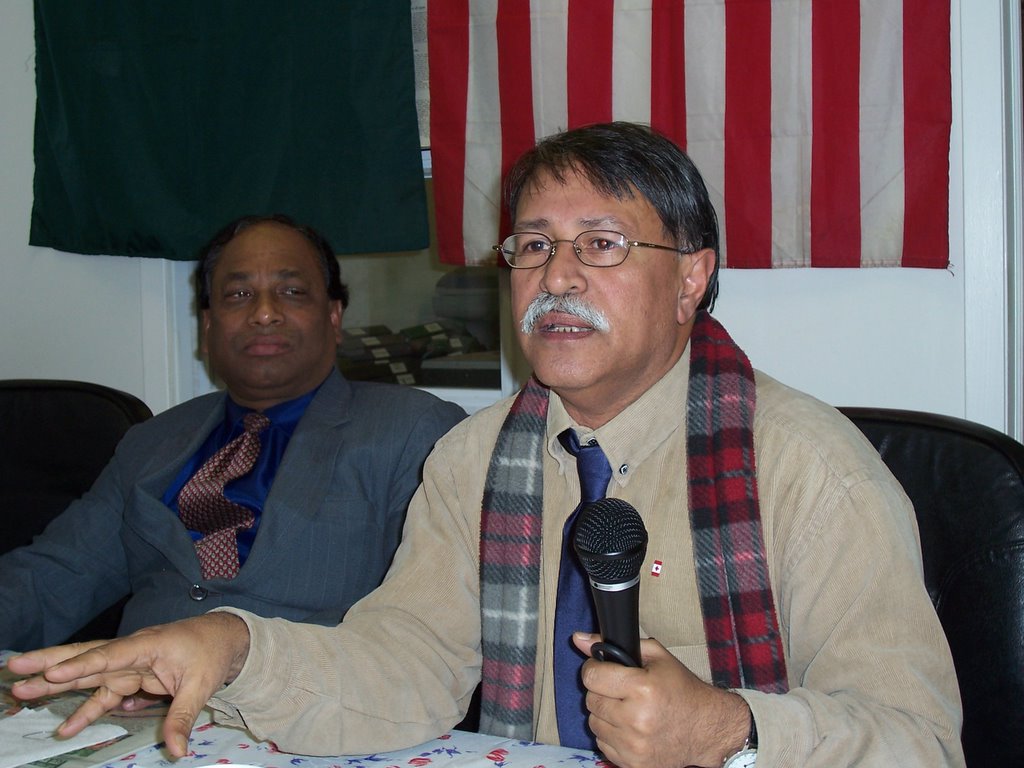
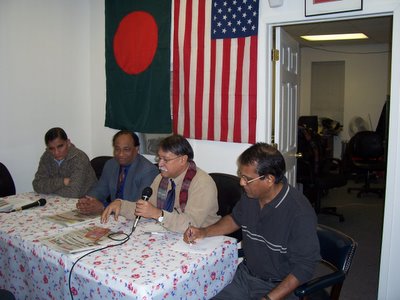
photo: discussion forum organised by Bangladesh Association of New York. I was flanked by (from the right) Mohammed Ali Siddiqui, senior journalist, Dr Mohsin Ali, president Bangladesh Human Rights Watch, and Sitangshu Guha, leader of Gatak Dalal Nirmul Committee

It was snowing on Sunday morning. Braving bad weather the meeting organised by Bangladesh Association of New York was well attended.


The discussion forum attended by Bangladeshi-American were mostly dissidents, or critical of the government's policy.


The meeting was organised by my good journalist friend, a social justice activist Sitangshu Guha on 4 December 2005. This was my first interaction with Bangladeshi-American in New York.

ModerIn the discussion spoke mostly dealing on religious freedom, Muslim jihadi, Islamic militancy, my ordeal with the dreaded military intelligence (DGFI), press freedom and current political development in Bangladesh.

Sitangshu left Bangladesh several years ago due to increasing economic and social insecurity as religous minority.

I met him after ages at a seminar on religious freedom in Bangladesh at Concordia University, Montreal last winter.

He is an activist on religious freedom with focus on persecution of Hindus, Ahmadiyyas Muslims, Christians & Buddhists in Bangladesh.

He systematically lobbies with US & European policymakers, human rights networks, media and civil societies to pressure on Bangladesh Islamic nationalists chauvinist government in a bid to halt persecution of religious and ethnic national minorities.

Alas he will never be able to return to Bangladesh for "fear of persecution" by security agencies. He is an outspoken activist about religious freedom in Bangladesh, now he is speaking against rising Islamic radicalism, which threatnes the basic principles of secularism and democracy.

I often wonder why the rights activists does not demand to lift impunity of the perpetrators engaged in crime against humanity. Some of the perpetrators who served the Bangladesh army and law enforcing agencies are presently immigrants in USA, Canada, Australia, New Zealand and Europe.

Canada has recently began investigating immigrants and refugee claimants under "War Crimes & Crime Against Humanity, 2000" [see separate blog]

I am myself, a journalist and researcher on social conflicts and a witness to persecution & ethnic cleansing of ethnic hill people in Chittagong Hill Tracts (CHT) in south-east Bangladesh during 1980-1991 by the Bangladesh anti-insurgency troops.

My articles were published on systematic persecution, genocide, and sexual abuse of women. In reality the military unleashed a reign of terror in CHT for two decades and committed series of crime against humanity.

That is a different issue, I will discuss that in a separate forum. Meanwhile I will begin a semi-official visit to New York and Washington from 3 December for 4-6 weeks.

Sitangshu Guha
sbguha@yahoo.com
sbguha@hotmail.com
sguha1@nyc.rr.com

For further studies on persecution of religious & ethnic minorities please visit: http://www.hrcbm.org/ http://web.amnesty.org/library/index/ENGASA130062001 http://web.amnesty.org/library/index/ENGASA130192004 http://web.amnesty.org/library/index/ENGASA130032004

Friday, September 07, 2007

Bangladesh emergency government crackdown on pro-democracy media

Photo: Emotional breakdown of CSB news staffs on hearing the that the station would be knocked off the air

SALEEM SAMAD


AFTER "limited censorship" on electronic media, Bangladesh’s only private 24-hour news channel has been silenced, just days after being warned not to broadcast footage of pro-democracy riots.

CSB television said officials from the telecommunications regulator visited with armed law enforcement personnel and took it off the air.

The officials of Bangladesh Telecom Regulatory Commission (BTRC) has asked CSB to explain doubts over the allocation of the frequency and accused the station on charges of forging a no-objection certificate, and asked its authorities to respond to an official notice in seven days.

But a senior CSB official argued that he was not convinced by the reason. The authorities are avoiding comment.

Until the TV station administration explains their conduct, the transmission would remain suspended.

Off Air
The order that many of the channel's journalists and employees described as "a surprise" move made most of them emotional.

Niaz Morshed Quaderi, head of the editorial section, read out a statement on behalf of the channel authorities.

"We had requested the BTRC officials to give us some time to announce that we are going to stop our transmission. But they did not agree," an emotional Morshed told bdnews24.com.

Accused
Earlier, on August 23, the interim government served notices cautioning private TV channels CSB and Ekushey TV for ‘breaching emergency rules’ by showing student agitation and country-wide pro-democracy riot.

The student protests in Dhaka quickly spread into three days of violent demonstrations across Bangladesh demanding an end to emergency rule.

The violence posed the most serious challenge to the emergency government since it took power six months ago.

In a statement, the Press Information Department said the two TV stations had aired ‘provocative news, video footage and talk shows against the government’ for the last few days.

"Several news items broadcast by the two TV channels breached the emergency rules. The government will take action if they continue to do so," law adviser Mainul Hosein told bdnews24.com on Aug 23.

But neither the PID statement nor the adviser in the phone interview explained which news item of the TV channels had exactly breached the emergency rules.

Gained Popularity
The first and lone 24-hours news channel, which only began broadcasting from March, went off air about 1800 local time (1200 GMT) on Thursday evening.

The channel started broadcasting on March 26 and earned popularity in covering big news events such as the arrests of two former prime ministers Sheikh Hasina and Khaleda Zia.

"It's quite unfortunate not only for us but for the entire media community that a popular station like ours had to be shut down without any notice," he said.

Watchdog Protest
Meanwhile, the international press watchdogs express grave concerns over the reported harassments, assaults and intimidation of journalists and gagging of the media in Bangladesh and denounces the repression of the journalists.

The law-enforcing agencies resorted to assaults of the journalists, both print and electronic, while they were covering the students protesting against the high-handedness of the army personnel and demanding the lifting of the state of emergency that suspended fundamental rights of the citizens.

The watchdog also notes that despite repeated government assurances of press freedom, the law enforcers resorted to detention, assaults, intimidation and humiliation of the media people particularly since the imposition of curfew on Aug 21.

Reporters Without Border (RSF), Committee to Protect Journalists (CPJ), International Federation of Journalists (IFJ) and Asia Media Forum (AMF) expresses concern over the government's overt intimidating two private TV channels — Ekushey and CSB, and covert attempts by telephonic instructions to media executives by the government agencies to gag the press.. #

The article was written based on reports of BBC online, Daily Star, The New Age and BDNews24.com

Saleem Samad, an Ashoka Fellow (USA) is a Bangladesh born journalist, presently living in exile in Canada for "crying wolf" when he discovered Jihadist sleeper cells in Bangladesh used by the remnants of Al-Qaeda and Taliban who fled the war torn Afghanistan after US led invasion in 2001. He presently edits DurDesh.net and also a blog BangladeshWatchdog

Friday, May 11, 2007

Bangladesh journalist Tasneem Khalil arrested

CNN.com

• Men from an army intelligence unit were behind the arrest, Khalil's wife said
• The men took Khalil's passport, cell phones, documents, wife said
Human Rights Watch's Asia director expresses extreme concern
• Khalil worked on HRW report last year about alleged torture by elite forces

(CNN) -- The Bangladeshi army arrested a Bangladesh journalist at his home early Friday for unknown reasons, according to his wife.

Tasneem Khalil writes for the Dhaka-based Daily Star and also works part-time for Human Rights Watch and as a stringer for several news organizations, including CNN.

Khalil's wife Sharmin Afsana Shuchi telephoned CNN to say that the men who arrested him were from an army intelligence unit.

In a statement, she said that four men in plainclothes identified themselves as belonging to "the joint task force." They refused to tell Khalil on what charges he was being arrested and cautioned him to be quiet "if you don't want anything else to happen," she said.

The men searched the house, took Khalil's passport and cell phones, two desktop computers and "all the documents, notepads, piles of paper, CDs and everything," she said. "They took it all away."

The men allegedly took Khalil to the Sangsad Bhavan army camp outside the parliament building in Dhaka.

The Bangladeshi army has detained thousands of people since declaring a state of emergency on January 11, Human Rights Watch said. Many of them have been tortured, the group said.

"We are extremely concerned about Tasneem Khalil's safety," said Brad Adams, Asia director at Human Rights Watch. "He has been a prominent voice in Bangladesh for human rights and the rule of law and has been threatened because of that."

Khalil is a noted investigative journalist who has published several controversial exposes of official corruption and abuse, particularly by security forces. Last year, he assisted Human Rights Watch in research for a 2006 report about torture and extrajudicial killings by Bangladesh elite security forces, said HRW press director Emma Daly.

According to Bangladeshi human rights groups, the army has detained tens of thousands of people since a state of emergency was declared on January 11, 2007. A number of those detained are picked up in the middle of the night, as Khalil was, and then tortured.

In Bangladesh, security forces have long been implicated in torture and extrajudicial killings. The killings have been attributed to members of the army, the police, and the Rapid Action Battalion (RAB), an elite anti-crime and anti-terrorism force. The Human Rights Watch report Khalil worked on, “Judge, Jury, and Executioner: Torture and Extrajudicial Killings by Bangladesh’s Elite Security Force,” focused on abuses by the RAB.

Killings in custody remain a persistent problem in Bangladesh. To date, no military personnel are known to have been held criminally responsible for any of the deaths.

Khalil was called in for questioning by military intelligence last week, apparently as part of the military’s campaign to intimidate independent journalists ahead of May 10, 2007, when the army’s three-month legal mandate for ruling under a state of emergency came to an end.

CNN and HRW have been in contact with Bangladesh's Special Envoy to the United States, Farook Sobhan, and other officials in attempts to find information about Khalil. Sobhan told CNN it was the first he'd heard about Khalil's arrest and promised to make inquiries. #

Judge, Jury, and Executioner: Torture and Extrajudicial Killings by Bangladesh’s Elite Security Force

POSTED: 1:10 a.m. EDT, May 11, 2007

Copyright 2007 CNN. All rights reserved.This material may not be published, broadcast, rewritten, or redistributed. Associated Press contributed to this report

Tuesday, May 01, 2007

'Democra-tators' aim at journalists

Western war reporters hog the glory, but, as Marina Jimenez writes, local watchdogs face the greatest risk
MARINA JIMENEZ

Saleem Samad, a genial refugee from Bangladesh, spends his days nabbing shoplifters and shushing disorderly customers as a security guard at a Chapters bookstore. But before he arrived in Toronto four years ago Mr. Samad, 55, was leading a very different kind of life.

A prominent journalist, Mr. Samad was forced to spend 55 days in a Dhaka prison, simply for having the audacity to criticize his own government.

The annual World Press Freedom Day, to be marked this Thursday, honours journalists who brave death or jail in pursuit of the truth.

Yet, all too often, the headlines focus on international stars such as Daniel Pearl, the Wall Street Journal reporter kidnapped and killed by extremists in Pakistan. In fact, far more tortured or slain journalists
are not war correspondents but locals such as Mr. Samad, attacked at home or in their newsrooms, often by agents of their own governments.

Often those governments are, like that of Bangladesh, nominally democratic, even members of the Commonwealth. But they are led by what Joel Simon of New York's Committee to Protect Journalists (CPJ)
calls "democra-tators," elected leaders with authoritarian streaks such as Vladimir Putin in Russia and Hugo Chavez in Venezuela.

These leaders have a deep mistrust for the institutions that limit their power, such as the judiciary and the press. Three journalists were killed in Russia last year, including Anna Politkovskaya, a Chechnya expert, last October.

In the case of Mr. Samad, he was behind bars from late November of 2002 until mid-January in 2003, and endured torture at the hands of military intelligence officers. When he asked his jailors what crime he had committed, they said he had smeared Bangladesh's good reputation with his exposes on Islamic terrorism, published locally and internationally, including in Time.

"They didn't like my writings on how the Bengali government was harbouring terrorists and jihadists," he says. "They wanted to know why I was trying to undermine a democratic government. They were trying to silence me."

Mr. Samad was lucky. He was released and in 2004 fled Bangladesh for a new life in Canada. Others are not so fortunate.

According to a report released last month by the Paris-based International News Safety Institute (INSI), the number of journalists killed on the job has escalated dramatically in recent years. In the past decade, more than a thousand media members have been slain, and in nine out of 10 cases, the perpetrators have never been prosecuted.

Reporters Without Borders tabulated the deaths of 81 journalists and 32 media assistants (drivers, translators, security and fixers) last year alone. It is the highest toll since 1994, when 103 died, half of
them in the Rwandan genocide. An additional 1,400 attacks or threats were carried out against journalists - many of them during election campaigns in Latin America, Africa and Eastern Europe. Another record.
That is why the focus for this year's World Press Freedom Day is impunity, and the need to bring to justice those who target and kill journalists.

"With the collapse of the Soviet Union in the 1990s and the return to democracy in Latin America, we saw an explosion of press freedom," notes Mr. Simon of the CPJ. "But, in this decade, there have been some losses."

Among them is Hrant Dink, editor of Turkey's only Armenian-language magazine and a well-known critic of the Turkish government's treatment of Armenians. He was shot in the street as he left his office on Jan. 19 of this year.

"In many countries, murder has become the easiest, cheapest and most effective way of silencing troublesome reporting and the more the killers get away with it, the more the spiral of death is forced upwards," INSI director Rodney Pinder said last month.

Not surprisingly, Iraq is the most dangerous place to report from.

The United Nations has become so concerned about the deliberate targeting of journalists that the Security Council even passed a special resolution on Dec. 23, 2006, condemning such attacks and reiterating the right of war correspondents to be treated as prisoners of war and accorded the rights of civilians under the Third Geneva Convention.

Many journalists, though, are killed not in war zones, but covering local politics or crime in countries such as Mexico, Russia, Iran and India. Marlene Garcia-Esperat lost her life for her articles documenting embezzlement and corruption in the local government in Tacurong, the Philippines. She was shot and killed in front of her two children on Easter weekend in 2005. Her bodyguards were off-duty.

Since most of these homicides are never resolved, the sense of impunity only encourages more killings, advocates say. There is also surprisingly little public sympathy for these cases, as though journalists somehow deserve to die for writing about the drug trade, or for criticizing an official state religion.

"There is a sense of complacency when a journalist and their family are killed or are under attack. The public finds it easier to support police officers or firefighters who die in the line of duty," notes Anne Game, executive director of the Toronto-based Canadian Journalists for Free Expression (CJFE). "But it's so important to try to protect journalists because they're really on the front line. Their freedom to speak enables others to."

Ross Howard, a journalism instructor at Vancouver's Langara College and president of Media and Democracy, a non-profit Canadian group, has crisscrossed the globe training journalists in the developing
world - only to see them targeted as they become less partisan and more professional.

"There is a tragic irony in post-conflict states in emerging democracies that the better the journalist gets, the more dangerous it becomes for him [or] her," he said.

"In countries such as Iran, Cuba or Pakistan, you cannot criticize the supreme leader, question the country's policies or even the economic corruption among the power-holders," notes Maryam Aghvami, an Iranian journalist who is now living in Toronto, where she heads the 70-member Journalists in Exile.

"If you are brave enough to do so, you are accused of acting against the country's national security, spreading lies and spying for Western powers."

Another key difference today is the erosion of the neutral-observer status that journalists used to enjoy. Radical or revolutionary groups no longer view journalists as conduits of information, but as lucrative
kidnapping targets.

Local columnists such as Saleem Samad are seen as "enemies of the state," and international correspondents as representatives of their own governments.

While there is no meaningful global data comparing journalists killed on the job with, for example, firefighters, Julie Payne, CJFE's manager, says the consequences are more profound. The killing of a journalist undermines one of the primary means of holding people accountable - and serves to silence others.

That is why advocacy organizations have begun funding legal cases overseas. CJFE, the CPJ and a number of other groups helped fund the case against Ms. Marlene Garcia-Esperat's killers. Three hit men were finally convicted and received life sentences in October, 2006, in Cebu - though the true power-holding authors of her death remain at large.

CJFE also manages the International Freedom of Expression Exchange (IFEX), which issues daily alerts of threats and violations to journalists all over the world.

As for Mr. Samad, he, his wife and adult son were all granted asylum here. Today, in addition to working security at the local bookstore, he edits Durdesh.net, a news portal for the South Asian diaspora.

He also looks forward to a term this fall as a visiting scholar at the University of California at Berkeley's School of Journalism.

Mr. Samad remains thankful to have escaped with his life. After he was released from prison, his house was put under surveillance, his phone lines tapped and his wife continually harassed.

"I kept a small bag ready, sure they would come back and arrest me," he recalls. "I was mentally prepared to pay with my life for my profession." #

Marina Jimenez is a senior feature writer with The Globe and Mail

Article first published in The Globe and Mail, Canada, April 28, 2007 Saturday

http://www.theglobeandmail.com/servlet/story/LAC.20070428.PRESS28/TPStory/Comment

Wednesday, February 08, 2006

Pakistani activist protest ethnic cleansing of Baloch


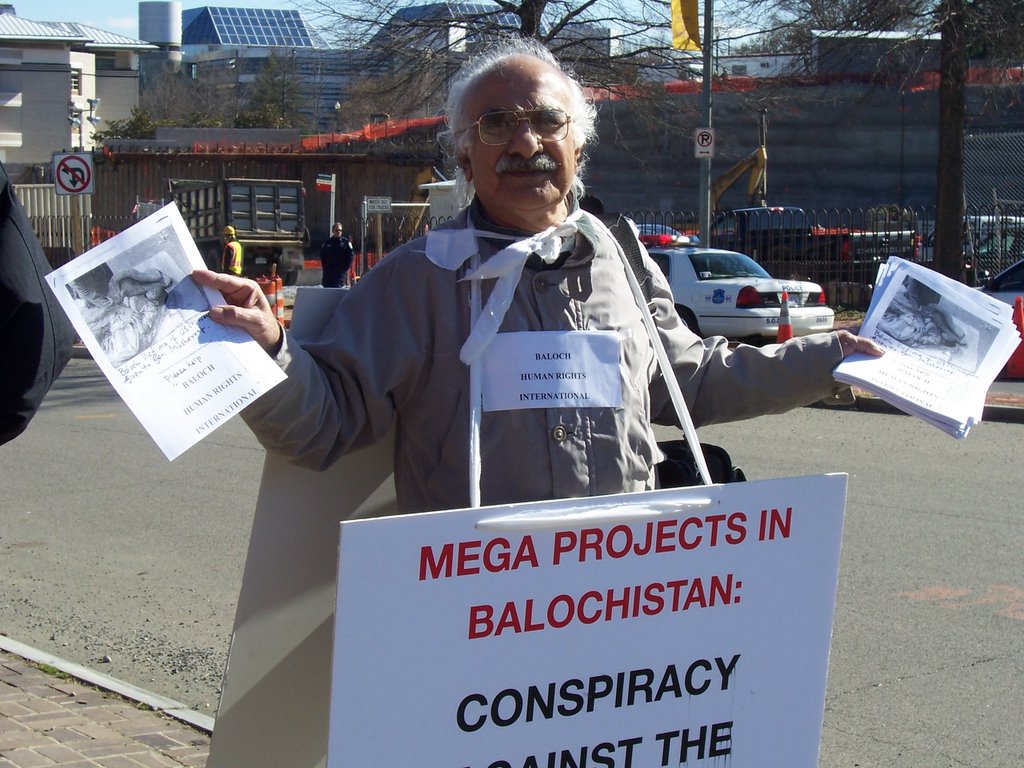
photos: Veteran Sindhi activist Rasul Baksh Palijo addressing demonstrators, Humaira Rahman interviewed & Dr. Malek Towghi demonstrating-pics/Saleem Samad

World Sindhi Institute, USA
Press Release
Monday, February 06, 2006

Rally for Rights

Washington, D.C: The Pakistan Embassy in Washington D.C. was the venue of the first of a series of protest rallies organized by the World Sindhi Institute in collaboration with Sindhi Association of North America, World Sindhi Congress, Global Pushtun Institute, Baloch Society of North America, Baloch Human Rights International, and Torture Abolition Survivors Supports Coalition International.

The rally was organized to register protest against the current military operation in Balochistan and the Government of Pakistan’s insistence on proceeding with the construction of mega dams on the river Indus.

Speaking at the rally Wahid Baloch of Bosnia, said that although General Musharaf claims that this operation is against three sardars this is not the case at all; this is a war between the Pakistan military and all the people of Balochistan. From Makran to Kohlu , from Kharan to Awaran and from Dera Bugti to Quetta all Baloch within Pakistan and abroad are united against the military dictatorship.

Walter Landry, Director of the of the Think Tank of Self Determination, said that every nation has the right to exercise self determination. He pointed out that it was this desire and this right that resulted in the break up of the Soviet Union and allowed these nations to develop according to their own needs and with their own resources.

Dr. Malek Towghi said that the Baloch have been struggling for their rights since 1947. He said that Gwadar port and Balochistan’s natural resources are for the Baloch

Basir Chand general secretary of the D.C. chapter of PPP said that the people are united against the military and condemn the operation in Balochistan; the ordinary people of Punjab do not want to go against the wishes of Sindh and believe that the decision to construct dams must be made by a representative government.

Saleem Samad a journalist from Bangladesh recalled how as a 19 year old student member of the Mukti Bahini he took part in the struggle against a brutal Pakistani army that raped hundreds of thousands of Bengali women. He said even though the Pakistan military tried to make us believe that they were invincible we fought valiantly because we were united in our goal of achieving liberation for a secular and independent Bangladesh. Perhaps had Bangladesh conducted proceedings against the war crimes of the Pakistani army at the time, our Baloch and Sindhi brothers and sisters would not be suffering today.

Humaira Rahman, Director of the World Sindhi Institute pointed out that when Shaukat Aziz and General Musharaf promote the agenda of the World Bank they act as foreign agents not as patriotic Pakistanis; when Sindhis and Baloch speak up against human rights violations they are branded as foreign agents by these same elements. She said that general Musharaf is using the tax dollars of Americans and Canadians to silence dissent against military rule while fooling western governments.

Rasul Baksh Palijo said that today’s Pakistan is not the Pakistan of Mohammed Ali Jinnah; Sindh joined Pakistan on the basis of the 1940 Lahore resolution which envisaged that the center would control defense, foreign affairs and currency while all other issues would remain in the domain of the provinces. The situation in the country today is fast approaching that which prevailed in 1971 when Bangladesh became independent. The acute shortage of river water in the delta and coastal areas is leading to desertification.
Munawar Laghari appealed to international organizations to conduct independent investigations of the human rights violations taking place in Sindh and Balochistan. He said that all the oppressed nations of Pakistan want to live within the federation of Pakistan with dignity, peace, and justice and equal rights. However the military and ruling elite are pushing them to a point where they feel that the only avenue left is that of self determination.

Wearing symbolic ajrak scarfs the rally participants delivered a memorandum to the Embassy of Pakistan outlining their concerns and demands. #

For more information, please call 202-223-1777 or email us at wsihq@worldsindhi.org. Visit www.worldsindhi.org for more information