Buy.com Monthly Coupon

Thursday, March 31, 2011

Bangladeshi doctors to face music for doctored autopsy report in flogging death

SALEEM SAMAD

FOUR BANGLADESH doctors in a government hospital will face music after probe committee found the post-mortem report of flogging death of Hena Begum was deliberately doctored.

A probe document submitted to the High Court on Thursday reveals that fifteen-year-old Begum of a sleepy town in west Bangladesh was raped by her 40-year-old cousin. Days later the village elders and Mullahs of the mosque ordered 101 lashes following a Fatwa (religious edict) in local arbitration on January 24.

Hena Akhter could not survive after 70 blows and collapsed. She was hospitalized but died a week later, and her death was judged a suicide by a local government hospital.

An independent English newspaper Daily Star in a first page article on February 7 raised doubts about the autopsy report from the small towns, which prompted the court to issue directives the same day for exhumation of Begum's body and a fresh autopsy.

An initial autopsy report cited no injuries and deemed her death a suicide. Begum's body was exhumed on orders from the High Court and a second autopsy concluded that she had died from wounds "of a homicidal nature" on her scalp, abdomen, back, chest, arms and legs.

The girl child’s death provoked widespread outrage in Bangladesh, where punishments in the name of Fatwa were outlawed last July.

The High Court asked the government to indict the doctors, including the civil surgeon of Shariatpur district, where Begum had lived, for preparing a "false post-mortem report to hide the real cause of her death."

The report stated that the doctors of Shariatpur General Hospital and district Civil Surgeon are “equally” guilty for deliberately not mentioning the injury marks on Begum's body. “The civil surgeon's negligence in preparing the autopsy report has been proved which is against medical ethics,” the report said.

Meanwhile, the police chief recommends departmental actions against two police officers who were accomplice of false investigation report.

"What sort of justice is this? My daughter has been beaten to death in the name of justice. If it had been a proper court then my daughter would not have died," Dorbesh Khan, Begum's father, reportedly said at the time. [ENDS]

Saleem Samad, an Ashoka Fellow is an award winning investigative journalist based in Bangladesh. He specializes in Jihad, forced migration, good governance and politics. He has recently returned from exile after living in Canada for six years. He could be reached at saleemsamad@hotmail.com

Wednesday, March 30, 2011

Government opts for respectable exit for Yunus, while global support pours

SALEEM SAMAD

AT THE time when Bangladesh government softened their reactive mood and have described that the ball is in Nobel laureate Professor Muhammad Yunus court, more global moral support pours in for the pioneer of banking the poor.

Two weeks ago a number of United States Senators and Congressman have expressed their concern over the humiliation faced by the international icon of microfinance.

A week ago Robert Blake, the visiting U.S. Assistant Secretary of State for South and Central Asian Affairs cautioned that if the Yunus issue remains unresolved, it will impact bilateral relations between Bangladesh and the United States.

The moral supports coincided with Bangladesh Supreme Court on Tuesday adjourned until April 4 the hearing on the petition filed by Muhammad Yunus seeking a stay order on the High Court judgment upholding his dismissal as the Grameen Bank managing director.

The central bank on March 2 removed the Nobel laureate from his position for allegedly flouting rules when he was reappointed in 1999. Yunus filed the petition against the order which the High Court had rejected earlier.

The unceremonious exit of Yunus has invited bricks and bouquets at home and globally. The government is embarrassed by blitzkrieg reaction from the press, politicians, celebrities and development practitioners.

Meantime a number of international microfinance organizations and civil society in Italy, Peru, Philippines and Pakistan have issued statements expressing support in solidarity with Prof. Yunus, founder of Grameen Bank.

Mario Baccini MP, President of the Italian Committee for Microcredit, Prof. Luisa Brunori of Bologna University, Sam Daley-Harris and European Member of Parliament Sylvia Cost said Prof Yunus with Grameen Bank have made significant mileage in social development in Bangladesh through microfinance. They are leading actors in the fight against poverty, writes private news agency United News of Bangladesh.

A statement of the Global Center for Development and Democracy (CGDD) and on behalf of President Alejando Toledo of Peru said “our organization, which cares about international development, has been following very closely the developments, and is very much concerned
about the progress which could be lost if the country’s leaders fail to appreciate what makes the Grameen Bank work.”

The statement further said that “If he (Toledo) becomes our next president, we expect to extend microloans to the poorest in our country in order to lift all Peruvians who are living below poverty conditions, out of it.”

Another letter to Prof Yunus from CARD MRI Family of Philippine said “our more than 1.5 million members and clients would like to assure you of our unwavering support to you as the Managing Director of Grameen Bank.”

An open letter from Kashf Foundation of Pakistan said Yunus and Grameen Bank are today global icons and torch-bearers for the mission to eradicate poverty, as well as to provide sustainable choices to poor households across the world.

It said the work of Grameen Bank has been replicated across 100 countries and has benefited over 170 million poor women globally. [ENDS]

Saleem Samad, an Ashoka Fellow is an award winning investigative journalist based in Bangladesh. He specializes in Jihad, forced migration, good governance and politics. He could be reached at saleemsamad@hotmail.com

Sexual abuse, exploitation of children in Bangladesh appalling

Lack of confidence of justice delivery system, sexual abuse and exploitation of children in Bangladesh skip prosecution

SALEEM SAMAD

CHILDREN IN Bangladesh are highly vulnerable to sexual abuse and exploitation, not only behind the closed doors of brothels but also in households, academic institutions and on the streets, revealed a UNICEF study on Tuesday.

Nearly 50 percent of the girls found engaged in prostitution had been sexually abused before joining the sex trade. The ‘slippery slope’ imagined from sexual abuse to prostitution to trafficking suggests a moral descent.

This study exposes the serious issue of sexual abuse of boys which has failed to be properly recognized in the past. Alarmingly, is that boys are becoming frequent clients of prostitutes.

Poverty-stricken Bangladesh boast of conservative culture, is an overwhelming Sunni Muslim majority where overtly speaking of sex is a social taboo.

The study made it clear that sexual abuse of children and their exploitation in prostitution derives from deep structural and societal problems coming from relationships between adults and children and how gender and sex are understood in a society of socio-economic inequality.

Most child sexual harassment cases in Bangladesh do not go for trial as the victims have no confidence in the justice delivery system. Efforts should be made to increase the number of prosecutions for sexual abuse of girls. Laws exist but the application is difficult, observed social anthropologist Therese Blanchet who conducted the study.

The study reveals that greater attention is given to ‘manage’ the dishonor and minimize social consequences while little support is offered to the traumatized person who is expected to silence her pain.

Despite the cultural limitation, the report recommends to introduce sex education in schools to prevent sexual abuse, stressed the need for strengthen employers’ responsibilities to prevent sexual abuse in the workplace.

Blanchet suggests that girls and adolescents engaged in prostitutions should be carefully looked at to improve ways to ‘recover’ and ‘reintegrate’ them back into the society.

UNICEF works for children's rights, their survival, development and protection calls for coordinated efforts to end both sexual abuse and commercial exploitation of children as child sexual abuse is widely ignored compared to commercial sexual exploitation and child trafficking. [ENDS]

Saleem Samad, an Ashoka Fellow is an award winning investigative journalist based in Bangladesh. He specializes in Jihad, forced migration, good governance and politics. He has recently returned from exile after living in Canada for six years. He could be reached at saleemsamad@hotmail.com

Tuesday, March 29, 2011

Sitangshu Guha cry for religious freedom


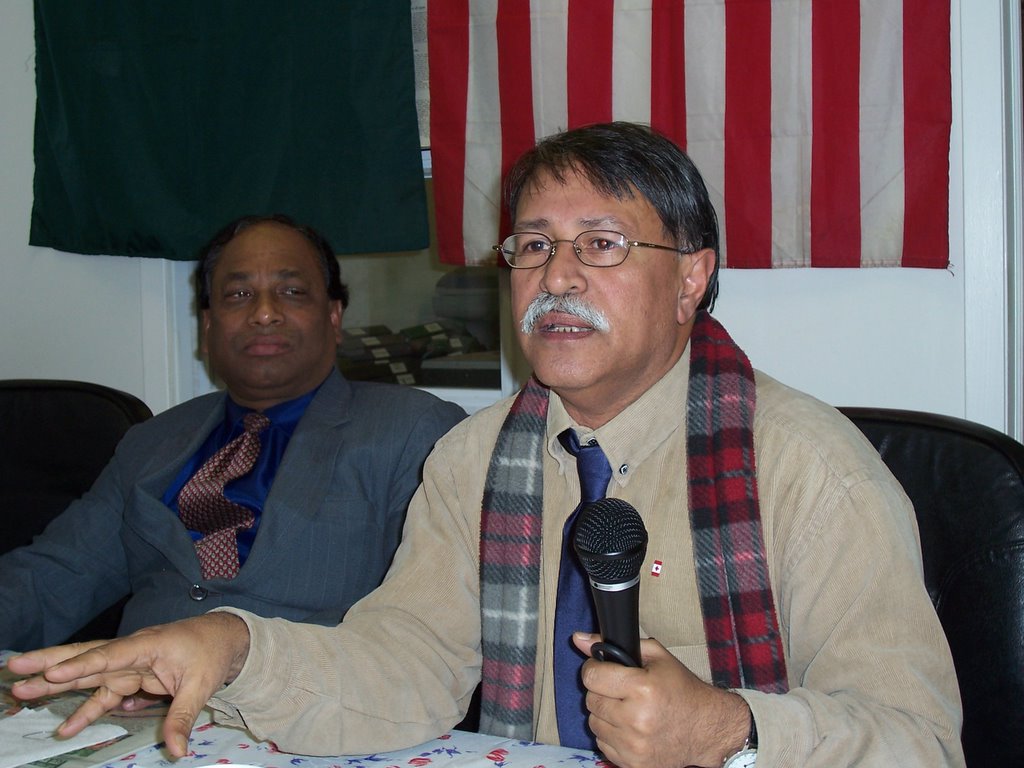
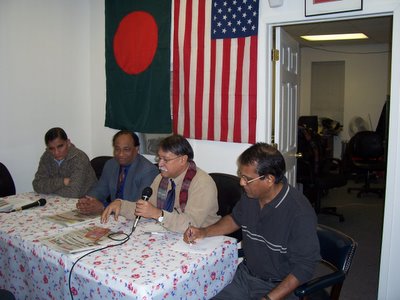
photo: discussion forum organised by Bangladesh Association of New York. I was flanked by (from the right) Mohammed Ali Siddiqui, senior journalist, Dr Mohsin Ali, president Bangladesh Human Rights Watch, and Sitangshu Guha, leader of Gatak Dalal Nirmul Committee

It was snowing on Sunday morning. Braving bad weather the meeting organised by Bangladesh Association of New York was well attended.


The discussion forum attended by Bangladeshi-American were mostly dissidents, or critical of the government's policy.


The meeting was organised by my good journalist friend, a social justice activist Sitangshu Guha on 4 December 2005. This was my first interaction with Bangladeshi-American in New York.

ModerIn the discussion spoke mostly dealing on religious freedom, Muslim jihadi, Islamic militancy, my ordeal with the dreaded military intelligence (DGFI), press freedom and current political development in Bangladesh.

Sitangshu left Bangladesh several years ago due to increasing economic and social insecurity as religous minority.

I met him after ages at a seminar on religious freedom in Bangladesh at Concordia University, Montreal last winter.

He is an activist on religious freedom with focus on persecution of Hindus, Ahmadiyyas Muslims, Christians & Buddhists in Bangladesh.

He systematically lobbies with US & European policymakers, human rights networks, media and civil societies to pressure on Bangladesh Islamic nationalists chauvinist government in a bid to halt persecution of religious and ethnic national minorities.

Alas he will never be able to return to Bangladesh for "fear of persecution" by security agencies. He is an outspoken activist about religious freedom in Bangladesh, now he is speaking against rising Islamic radicalism, which threatnes the basic principles of secularism and democracy.

I often wonder why the rights activists does not demand to lift impunity of the perpetrators engaged in crime against humanity. Some of the perpetrators who served the Bangladesh army and law enforcing agencies are presently immigrants in USA, Canada, Australia, New Zealand and Europe.

Canada has recently began investigating immigrants and refugee claimants under "War Crimes & Crime Against Humanity, 2000" [see separate blog]

I am myself, a journalist and researcher on social conflicts and a witness to persecution & ethnic cleansing of ethnic hill people in Chittagong Hill Tracts (CHT) in south-east Bangladesh during 1980-1991 by the Bangladesh anti-insurgency troops.

My articles were published on systematic persecution, genocide, and sexual abuse of women. In reality the military unleashed a reign of terror in CHT for two decades and committed series of crime against humanity.

That is a different issue, I will discuss that in a separate forum. Meanwhile I will begin a semi-official visit to New York and Washington from 3 December for 4-6 weeks.

Sitangshu Guha
sbguha@yahoo.com
sbguha@hotmail.com
sguha1@nyc.rr.com

For further studies on persecution of religious & ethnic minorities please visit: http://www.hrcbm.org/ http://web.amnesty.org/library/index/ENGASA130062001 http://web.amnesty.org/library/index/ENGASA130192004 http://web.amnesty.org/library/index/ENGASA130032004

Friday, September 07, 2007

Bangladesh emergency government crackdown on pro-democracy media

Photo: Emotional breakdown of CSB news staffs on hearing the that the station would be knocked off the air

SALEEM SAMAD


AFTER "limited censorship" on electronic media, Bangladesh’s only private 24-hour news channel has been silenced, just days after being warned not to broadcast footage of pro-democracy riots.

CSB television said officials from the telecommunications regulator visited with armed law enforcement personnel and took it off the air.

The officials of Bangladesh Telecom Regulatory Commission (BTRC) has asked CSB to explain doubts over the allocation of the frequency and accused the station on charges of forging a no-objection certificate, and asked its authorities to respond to an official notice in seven days.

But a senior CSB official argued that he was not convinced by the reason. The authorities are avoiding comment.

Until the TV station administration explains their conduct, the transmission would remain suspended.

Off Air
The order that many of the channel's journalists and employees described as "a surprise" move made most of them emotional.

Niaz Morshed Quaderi, head of the editorial section, read out a statement on behalf of the channel authorities.

"We had requested the BTRC officials to give us some time to announce that we are going to stop our transmission. But they did not agree," an emotional Morshed told bdnews24.com.

Accused
Earlier, on August 23, the interim government served notices cautioning private TV channels CSB and Ekushey TV for ‘breaching emergency rules’ by showing student agitation and country-wide pro-democracy riot.

The student protests in Dhaka quickly spread into three days of violent demonstrations across Bangladesh demanding an end to emergency rule.

The violence posed the most serious challenge to the emergency government since it took power six months ago.

In a statement, the Press Information Department said the two TV stations had aired ‘provocative news, video footage and talk shows against the government’ for the last few days.

"Several news items broadcast by the two TV channels breached the emergency rules. The government will take action if they continue to do so," law adviser Mainul Hosein told bdnews24.com on Aug 23.

But neither the PID statement nor the adviser in the phone interview explained which news item of the TV channels had exactly breached the emergency rules.

Gained Popularity
The first and lone 24-hours news channel, which only began broadcasting from March, went off air about 1800 local time (1200 GMT) on Thursday evening.

The channel started broadcasting on March 26 and earned popularity in covering big news events such as the arrests of two former prime ministers Sheikh Hasina and Khaleda Zia.

"It's quite unfortunate not only for us but for the entire media community that a popular station like ours had to be shut down without any notice," he said.

Watchdog Protest
Meanwhile, the international press watchdogs express grave concerns over the reported harassments, assaults and intimidation of journalists and gagging of the media in Bangladesh and denounces the repression of the journalists.

The law-enforcing agencies resorted to assaults of the journalists, both print and electronic, while they were covering the students protesting against the high-handedness of the army personnel and demanding the lifting of the state of emergency that suspended fundamental rights of the citizens.

The watchdog also notes that despite repeated government assurances of press freedom, the law enforcers resorted to detention, assaults, intimidation and humiliation of the media people particularly since the imposition of curfew on Aug 21.

Reporters Without Border (RSF), Committee to Protect Journalists (CPJ), International Federation of Journalists (IFJ) and Asia Media Forum (AMF) expresses concern over the government's overt intimidating two private TV channels — Ekushey and CSB, and covert attempts by telephonic instructions to media executives by the government agencies to gag the press.. #

The article was written based on reports of BBC online, Daily Star, The New Age and BDNews24.com

Saleem Samad, an Ashoka Fellow (USA) is a Bangladesh born journalist, presently living in exile in Canada for "crying wolf" when he discovered Jihadist sleeper cells in Bangladesh used by the remnants of Al-Qaeda and Taliban who fled the war torn Afghanistan after US led invasion in 2001. He presently edits DurDesh.net and also a blog BangladeshWatchdog

Friday, May 11, 2007

Bangladesh journalist Tasneem Khalil arrested

CNN.com

• Men from an army intelligence unit were behind the arrest, Khalil's wife said
• The men took Khalil's passport, cell phones, documents, wife said
Human Rights Watch's Asia director expresses extreme concern
• Khalil worked on HRW report last year about alleged torture by elite forces

(CNN) -- The Bangladeshi army arrested a Bangladesh journalist at his home early Friday for unknown reasons, according to his wife.

Tasneem Khalil writes for the Dhaka-based Daily Star and also works part-time for Human Rights Watch and as a stringer for several news organizations, including CNN.

Khalil's wife Sharmin Afsana Shuchi telephoned CNN to say that the men who arrested him were from an army intelligence unit.

In a statement, she said that four men in plainclothes identified themselves as belonging to "the joint task force." They refused to tell Khalil on what charges he was being arrested and cautioned him to be quiet "if you don't want anything else to happen," she said.

The men searched the house, took Khalil's passport and cell phones, two desktop computers and "all the documents, notepads, piles of paper, CDs and everything," she said. "They took it all away."

The men allegedly took Khalil to the Sangsad Bhavan army camp outside the parliament building in Dhaka.

The Bangladeshi army has detained thousands of people since declaring a state of emergency on January 11, Human Rights Watch said. Many of them have been tortured, the group said.

"We are extremely concerned about Tasneem Khalil's safety," said Brad Adams, Asia director at Human Rights Watch. "He has been a prominent voice in Bangladesh for human rights and the rule of law and has been threatened because of that."

Khalil is a noted investigative journalist who has published several controversial exposes of official corruption and abuse, particularly by security forces. Last year, he assisted Human Rights Watch in research for a 2006 report about torture and extrajudicial killings by Bangladesh elite security forces, said HRW press director Emma Daly.

According to Bangladeshi human rights groups, the army has detained tens of thousands of people since a state of emergency was declared on January 11, 2007. A number of those detained are picked up in the middle of the night, as Khalil was, and then tortured.

In Bangladesh, security forces have long been implicated in torture and extrajudicial killings. The killings have been attributed to members of the army, the police, and the Rapid Action Battalion (RAB), an elite anti-crime and anti-terrorism force. The Human Rights Watch report Khalil worked on, “Judge, Jury, and Executioner: Torture and Extrajudicial Killings by Bangladesh’s Elite Security Force,” focused on abuses by the RAB.

Killings in custody remain a persistent problem in Bangladesh. To date, no military personnel are known to have been held criminally responsible for any of the deaths.

Khalil was called in for questioning by military intelligence last week, apparently as part of the military’s campaign to intimidate independent journalists ahead of May 10, 2007, when the army’s three-month legal mandate for ruling under a state of emergency came to an end.

CNN and HRW have been in contact with Bangladesh's Special Envoy to the United States, Farook Sobhan, and other officials in attempts to find information about Khalil. Sobhan told CNN it was the first he'd heard about Khalil's arrest and promised to make inquiries. #

Judge, Jury, and Executioner: Torture and Extrajudicial Killings by Bangladesh’s Elite Security Force

POSTED: 1:10 a.m. EDT, May 11, 2007

Copyright 2007 CNN. All rights reserved.This material may not be published, broadcast, rewritten, or redistributed. Associated Press contributed to this report

Tuesday, May 01, 2007

'Democra-tators' aim at journalists

Western war reporters hog the glory, but, as Marina Jimenez writes, local watchdogs face the greatest risk
MARINA JIMENEZ

Saleem Samad, a genial refugee from Bangladesh, spends his days nabbing shoplifters and shushing disorderly customers as a security guard at a Chapters bookstore. But before he arrived in Toronto four years ago Mr. Samad, 55, was leading a very different kind of life.

A prominent journalist, Mr. Samad was forced to spend 55 days in a Dhaka prison, simply for having the audacity to criticize his own government.

The annual World Press Freedom Day, to be marked this Thursday, honours journalists who brave death or jail in pursuit of the truth.

Yet, all too often, the headlines focus on international stars such as Daniel Pearl, the Wall Street Journal reporter kidnapped and killed by extremists in Pakistan. In fact, far more tortured or slain journalists
are not war correspondents but locals such as Mr. Samad, attacked at home or in their newsrooms, often by agents of their own governments.

Often those governments are, like that of Bangladesh, nominally democratic, even members of the Commonwealth. But they are led by what Joel Simon of New York's Committee to Protect Journalists (CPJ)
calls "democra-tators," elected leaders with authoritarian streaks such as Vladimir Putin in Russia and Hugo Chavez in Venezuela.

These leaders have a deep mistrust for the institutions that limit their power, such as the judiciary and the press. Three journalists were killed in Russia last year, including Anna Politkovskaya, a Chechnya expert, last October.

In the case of Mr. Samad, he was behind bars from late November of 2002 until mid-January in 2003, and endured torture at the hands of military intelligence officers. When he asked his jailors what crime he had committed, they said he had smeared Bangladesh's good reputation with his exposes on Islamic terrorism, published locally and internationally, including in Time.

"They didn't like my writings on how the Bengali government was harbouring terrorists and jihadists," he says. "They wanted to know why I was trying to undermine a democratic government. They were trying to silence me."

Mr. Samad was lucky. He was released and in 2004 fled Bangladesh for a new life in Canada. Others are not so fortunate.

According to a report released last month by the Paris-based International News Safety Institute (INSI), the number of journalists killed on the job has escalated dramatically in recent years. In the past decade, more than a thousand media members have been slain, and in nine out of 10 cases, the perpetrators have never been prosecuted.

Reporters Without Borders tabulated the deaths of 81 journalists and 32 media assistants (drivers, translators, security and fixers) last year alone. It is the highest toll since 1994, when 103 died, half of
them in the Rwandan genocide. An additional 1,400 attacks or threats were carried out against journalists - many of them during election campaigns in Latin America, Africa and Eastern Europe. Another record.
That is why the focus for this year's World Press Freedom Day is impunity, and the need to bring to justice those who target and kill journalists.

"With the collapse of the Soviet Union in the 1990s and the return to democracy in Latin America, we saw an explosion of press freedom," notes Mr. Simon of the CPJ. "But, in this decade, there have been some losses."

Among them is Hrant Dink, editor of Turkey's only Armenian-language magazine and a well-known critic of the Turkish government's treatment of Armenians. He was shot in the street as he left his office on Jan. 19 of this year.

"In many countries, murder has become the easiest, cheapest and most effective way of silencing troublesome reporting and the more the killers get away with it, the more the spiral of death is forced upwards," INSI director Rodney Pinder said last month.

Not surprisingly, Iraq is the most dangerous place to report from.

The United Nations has become so concerned about the deliberate targeting of journalists that the Security Council even passed a special resolution on Dec. 23, 2006, condemning such attacks and reiterating the right of war correspondents to be treated as prisoners of war and accorded the rights of civilians under the Third Geneva Convention.

Many journalists, though, are killed not in war zones, but covering local politics or crime in countries such as Mexico, Russia, Iran and India. Marlene Garcia-Esperat lost her life for her articles documenting embezzlement and corruption in the local government in Tacurong, the Philippines. She was shot and killed in front of her two children on Easter weekend in 2005. Her bodyguards were off-duty.

Since most of these homicides are never resolved, the sense of impunity only encourages more killings, advocates say. There is also surprisingly little public sympathy for these cases, as though journalists somehow deserve to die for writing about the drug trade, or for criticizing an official state religion.

"There is a sense of complacency when a journalist and their family are killed or are under attack. The public finds it easier to support police officers or firefighters who die in the line of duty," notes Anne Game, executive director of the Toronto-based Canadian Journalists for Free Expression (CJFE). "But it's so important to try to protect journalists because they're really on the front line. Their freedom to speak enables others to."

Ross Howard, a journalism instructor at Vancouver's Langara College and president of Media and Democracy, a non-profit Canadian group, has crisscrossed the globe training journalists in the developing
world - only to see them targeted as they become less partisan and more professional.

"There is a tragic irony in post-conflict states in emerging democracies that the better the journalist gets, the more dangerous it becomes for him [or] her," he said.

"In countries such as Iran, Cuba or Pakistan, you cannot criticize the supreme leader, question the country's policies or even the economic corruption among the power-holders," notes Maryam Aghvami, an Iranian journalist who is now living in Toronto, where she heads the 70-member Journalists in Exile.

"If you are brave enough to do so, you are accused of acting against the country's national security, spreading lies and spying for Western powers."

Another key difference today is the erosion of the neutral-observer status that journalists used to enjoy. Radical or revolutionary groups no longer view journalists as conduits of information, but as lucrative
kidnapping targets.

Local columnists such as Saleem Samad are seen as "enemies of the state," and international correspondents as representatives of their own governments.

While there is no meaningful global data comparing journalists killed on the job with, for example, firefighters, Julie Payne, CJFE's manager, says the consequences are more profound. The killing of a journalist undermines one of the primary means of holding people accountable - and serves to silence others.

That is why advocacy organizations have begun funding legal cases overseas. CJFE, the CPJ and a number of other groups helped fund the case against Ms. Marlene Garcia-Esperat's killers. Three hit men were finally convicted and received life sentences in October, 2006, in Cebu - though the true power-holding authors of her death remain at large.

CJFE also manages the International Freedom of Expression Exchange (IFEX), which issues daily alerts of threats and violations to journalists all over the world.

As for Mr. Samad, he, his wife and adult son were all granted asylum here. Today, in addition to working security at the local bookstore, he edits Durdesh.net, a news portal for the South Asian diaspora.

He also looks forward to a term this fall as a visiting scholar at the University of California at Berkeley's School of Journalism.

Mr. Samad remains thankful to have escaped with his life. After he was released from prison, his house was put under surveillance, his phone lines tapped and his wife continually harassed.

"I kept a small bag ready, sure they would come back and arrest me," he recalls. "I was mentally prepared to pay with my life for my profession." #

Marina Jimenez is a senior feature writer with The Globe and Mail

Article first published in The Globe and Mail, Canada, April 28, 2007 Saturday

http://www.theglobeandmail.com/servlet/story/LAC.20070428.PRESS28/TPStory/Comment

Wednesday, February 08, 2006

Pakistani activist protest ethnic cleansing of Baloch


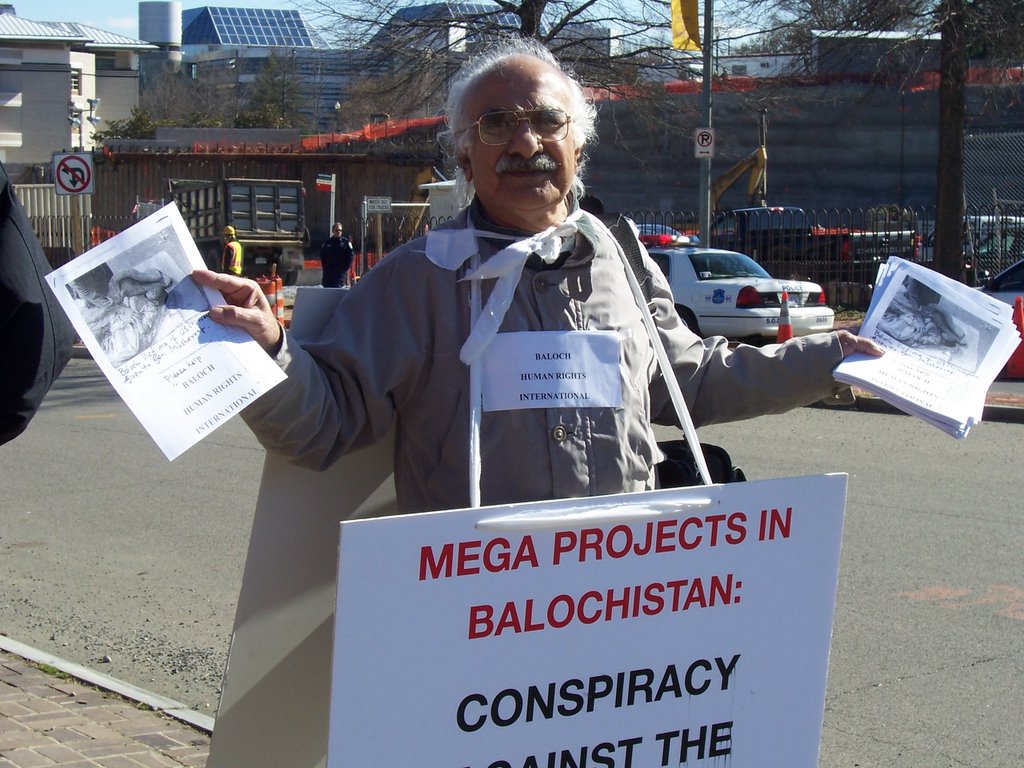
photos: Veteran Sindhi activist Rasul Baksh Palijo addressing demonstrators, Humaira Rahman interviewed & Dr. Malek Towghi demonstrating-pics/Saleem Samad

World Sindhi Institute, USA
Press Release
Monday, February 06, 2006

Rally for Rights

Washington, D.C: The Pakistan Embassy in Washington D.C. was the venue of the first of a series of protest rallies organized by the World Sindhi Institute in collaboration with Sindhi Association of North America, World Sindhi Congress, Global Pushtun Institute, Baloch Society of North America, Baloch Human Rights International, and Torture Abolition Survivors Supports Coalition International.

The rally was organized to register protest against the current military operation in Balochistan and the Government of Pakistan’s insistence on proceeding with the construction of mega dams on the river Indus.

Speaking at the rally Wahid Baloch of Bosnia, said that although General Musharaf claims that this operation is against three sardars this is not the case at all; this is a war between the Pakistan military and all the people of Balochistan. From Makran to Kohlu , from Kharan to Awaran and from Dera Bugti to Quetta all Baloch within Pakistan and abroad are united against the military dictatorship.

Walter Landry, Director of the of the Think Tank of Self Determination, said that every nation has the right to exercise self determination. He pointed out that it was this desire and this right that resulted in the break up of the Soviet Union and allowed these nations to develop according to their own needs and with their own resources.

Dr. Malek Towghi said that the Baloch have been struggling for their rights since 1947. He said that Gwadar port and Balochistan’s natural resources are for the Baloch

Basir Chand general secretary of the D.C. chapter of PPP said that the people are united against the military and condemn the operation in Balochistan; the ordinary people of Punjab do not want to go against the wishes of Sindh and believe that the decision to construct dams must be made by a representative government.

Saleem Samad a journalist from Bangladesh recalled how as a 19 year old student member of the Mukti Bahini he took part in the struggle against a brutal Pakistani army that raped hundreds of thousands of Bengali women. He said even though the Pakistan military tried to make us believe that they were invincible we fought valiantly because we were united in our goal of achieving liberation for a secular and independent Bangladesh. Perhaps had Bangladesh conducted proceedings against the war crimes of the Pakistani army at the time, our Baloch and Sindhi brothers and sisters would not be suffering today.

Humaira Rahman, Director of the World Sindhi Institute pointed out that when Shaukat Aziz and General Musharaf promote the agenda of the World Bank they act as foreign agents not as patriotic Pakistanis; when Sindhis and Baloch speak up against human rights violations they are branded as foreign agents by these same elements. She said that general Musharaf is using the tax dollars of Americans and Canadians to silence dissent against military rule while fooling western governments.

Rasul Baksh Palijo said that today’s Pakistan is not the Pakistan of Mohammed Ali Jinnah; Sindh joined Pakistan on the basis of the 1940 Lahore resolution which envisaged that the center would control defense, foreign affairs and currency while all other issues would remain in the domain of the provinces. The situation in the country today is fast approaching that which prevailed in 1971 when Bangladesh became independent. The acute shortage of river water in the delta and coastal areas is leading to desertification.
Munawar Laghari appealed to international organizations to conduct independent investigations of the human rights violations taking place in Sindh and Balochistan. He said that all the oppressed nations of Pakistan want to live within the federation of Pakistan with dignity, peace, and justice and equal rights. However the military and ruling elite are pushing them to a point where they feel that the only avenue left is that of self determination.

Wearing symbolic ajrak scarfs the rally participants delivered a memorandum to the Embassy of Pakistan outlining their concerns and demands. #

For more information, please call 202-223-1777 or email us at wsihq@worldsindhi.org. Visit www.worldsindhi.org for more information

Thursday, December 22, 2005

Color of Faith screened in Bangladesh


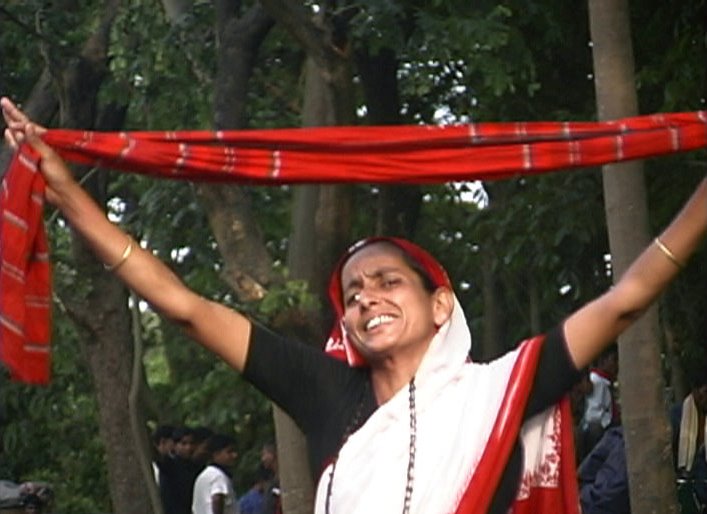
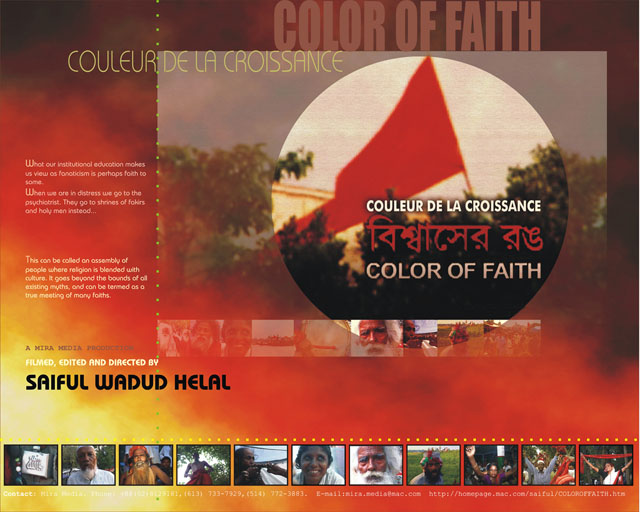
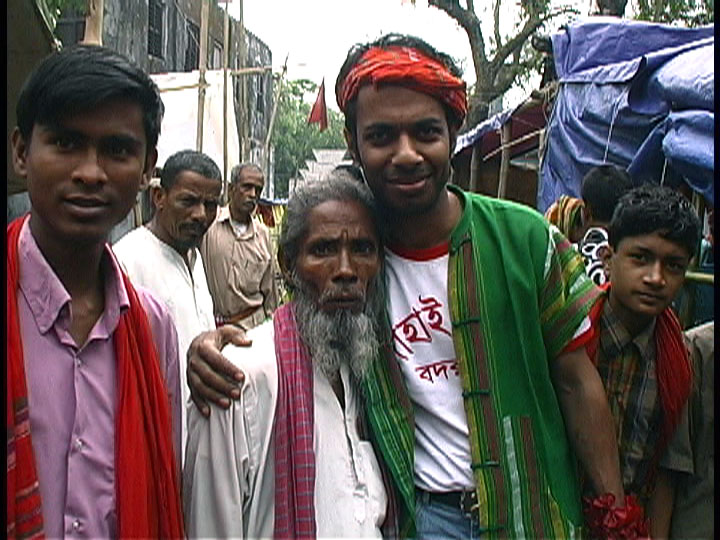
photo: The filmmaker (in green) at spring festival of half-naked Sufi Saint - Langta Baba (right); the poster displayed at Montreal film festival (above); a village women shake at tune of Baul songs at the religious congregation (top)
Bangladesh born Canadian filmmaker Saiful Wadud Helal's short film COLOR OF FAITH (Bishwsher Rong) will be screened at Bangladesh International Short & Independent Film Festival 2005, Dhaka, 22-30 December.

After successful screening at prestigious Montreal Film Festival 2005, and South Asian Film Festival in December 2005 at New York, the film will now be screened in the his homeland where it was filmed last spring.

Helal is a journalist, television program director and a filmmaker. His previous two films Poet and Bonjour Montreal were released in 2000.

Each year at the end of spring hundreds of thousands of people gather for a week-long religious congregation in a remote village Badarpur, in Bangladesh. They sing and dance in remembrance of their saint “Langta”. Hundreds of similar religious congregations of Sufi Saints are held in Bangladesh throughout the year.

Langta Baba, a Muslim Saint was a Sufi practitioner in ancient Bengal, who encouraged disciples from all faiths to believe in humanism. The different colors of faith blended into one, to experience the unity of all human beings. The villagers felt great pride that Langta Baba was a Bangla-speaking native who brought harmony between all faiths through special spiritual movement.

Albeit the film depicts a strong political statement through the simple language of the heart, and has also given an opportunity to the audience to interact with the disciples who remembers the Saint.

The people of this country struggle every day with nature for survival. They acknowledge, appreciate and revere all the forces of nature. Religious faith provides them with added strength and courage. The sapling of religious faith brought over by Sufis and saints from the dry, scorched earth of Middle East & mostly from Central Asia has blossomed in the moist, olden soil of Bangladesh. Nevertheless, the fruit it bore is considered forbidden by fundamentalists- as forbidden as Gandham (the forbidden fruit of paradise).

Today any and every place- from Bangladesh to Iraq, from Madrid to London- is vulnerable to the threats of the prevailing "culture of bombing". Even the deceased saint and his followers cannot escape this fear of terror. In a world where people blinded with self-interest don't hesitate to give up their values at a bargained price, can we possibly call these selfless, greedless people "fanatics"?

In ancient Bengal, the Sufi's practiced secularism and oneness of people. Recently the Islamist and Jihadis in Bangladesh declared the Sufi disciples as non-Muslim. There places were bombed, which mayhemmaiyham and fear. The fabric of secularism in the villages of floodplain Bengal has once again threatened.#

Please visit Saiful Wadud Helal's site for more information: http://homepage.mac.com/saiful/COLOROFFAITH.htm

Tuesday, November 29, 2005

Crying wolf in exile


Let hundred flowers bloom - Mao tse Tung
I am 53 year old writer-journalist and researcher on conflict & peace in South Asia.

I always disapproved the idea with many regarding the political dissidents to flee the country and claim political asylum in the west. I mean settling in Europe or North America. This, I believe will certainly legitimize the wrong-doings of the developed nations discrimination of the poor, imposed war and economic exploitation. I ridiculed the writers, journalists, theatre activists and freethinkers in Bangladesh who have claimed refugee in the west in “fear of persecution.”

When I was elected for a 3-year Ashoka Fellowship in 1991 by the Washington based foundation Ashoka-Innovators for the Public, Bill Drayton, the founder and CEO of Ashoka wrote my profile. He writes: “…Saleem who won't emigrate and who care (about Bangladesh society)…”

Therefore, my options became limited. Whether to abandon my birthplace Bangladesh! The nation of 140 million was born in 1971 after a bloody war with the marauding Pakistan army. I was only 19 years old and I joined the “Mukti Bahini” (Liberation Forces) during the Bangladesh war of independence. I was asked to return to the capital Dhaka, when the guerrilla commander major Haider found that I fairly spoke and understand English and Urdu (language spoken in Pakistan). I joined the team with intelligence and logistics unit of the Mukti Bahini. That is another story!

At 50 plus age, it is likely that I may not find suitable job in Canada. Not as a journalist, writer or researcher. It will take months, maybe years to understand the history, culture, customs, usage of Canadian-English and also have to understand French in a bilingual nation. I am unable to predict my future in this country.

I experienced couple of shocks in a row. I had to quit my job with a premier English daily Bangladesh Observer and Reporters sans frontières (RSF) as soon as I left the base. While the job with TIME magazine (Asia edition) was made conditional. I informed them that the Canadian authority have accepted my claim for political asylum. TIME Asia editor Michael Elliot however advised that I could be relocated in South Asia, preferably in India (but in no circumstances in Bangladesh) if I wish to continue working with TIME. Of course, I will and I agreed!

Meanwhile the Canadian Immigration and Refugee Board (IRB) have accepted my claim for refugee protection - within a shortest period of 55 days, thus becoming a "convention refugee". I also began to receive a modest monthly social benefit for house rent and food for my survival. Also an international human rights organisation raised funds to support my livelihood for first few months. Half of the money was instead submitted for paying the immigration fees for my family.

What causes alarms was that my family cannot join me immediately, despite they are living in fear of harassment by the security agencies. Twice the security intelligence raided my home in the capital Dhaka, despite knowing that I am in Canada. Unless the Canadian authority expedites immigration formalities, my family will continue to live in fear. Good news is that the Canadian authority assured that my application for Permanent Residents (PR) card (equivalent to Green Card in US) is "under process" on fast-track.

My son often curiously asks me while on MSN how do I spend my day? What is your day's plan? I repeated the same story over and over again. I usually wake up early in the morning. I skip breakfast and have brunch during weekdays. I check emails while I am online throughout the day. The public bus transport swivel though the snow-laden capital Ottawa which takes me to the downtown main library. I browse the racks for music CDs, DVDs and of course books. Lazily I read magazines and journals there. In the afternoon I walk from the library to Rideau shopping mall - always busy and warm in the cold winter. I drink tea from Tim Hortons and wait till my friends joins me on their way home from work.

The situation of journalism has been suitably illustrated by the New York based Committee to Protect Journalists (CPJ). The mission report describes: “Bangladesh, …… where crime, politics, and violence all cross paths, making independent journalism in this country of 146 million people a very dangerous profession. Political officials routinely punish journalists who expose corruption by ordering political activist henchmen to beat them.”

The country apparently a Muslim majoritarian nation and three “democratically” elected “autocratic” governments changed power through free, fair and regular elections since 1991.

Describing the social disappointment, Bill Drayton continues: “Frustrated like so many of his countrymen by a sense that the promise of Golden Bangladesh is being lost in a sink of disappointing leadership, Saleem feels he can help energize a group in society that can fill some of the agenda-setting vacuum-the most concerned and able journalists around the country, especially those close to its grassroots realities beyond the capital.”

Often I am invited to speak to group of Bangladeshi-Canadian community at Montreal and Toronto and obviously lament about the appalling human rights conditions and poor freedom of press.

I have developed annoyance and frustration over the unspeakable state of religious freedom, poor governance, criminalization of politics and the upper hand of the military intelligence since the Islamic nationalist government in Bangladesh swept into power in October 2001.

"When they (journalists) investigate transparency of civil and military bureaucracy, and democratic accountability of elected representatives, which makes them more vulnerable. The political class—especially the local one—are unable to accept these positive changes," RSF Mission Report in March 2002 quotes me.

My ordeal began 24 years ago while reporting on the insurgency in the Bangladesh south-eastern region. The army was engaged in a bush-war with the indigenous Mongoloid Buddhist in Chittagong Hill Tracts (CHT). The human rights groups blamed the Bangladesh army for ethnic cleansing, genocide, extra-judicial killing and arbitrary detention, which were based on my reportage in the newspaper.

Since early 1980 I was reporting on the counter-insurgency operation by the Bangladesh Army for The New Nation, a local English daily. One midnight on March 27, 1981, I was picked up by the dreaded military intelligence outfit Directorate General of Forces Intelligence (DGFI) at Rangamati, a regional town in CHT for my despatches, which exposed the flagrant abuse of human rights.

For five days I was kept blindfolded, handcuffed, refused food and drink, confined in a tiny dark cell and intermittingly tortured during interrogation. The torture caused damages to my right knee, dislocation of right shoulder joint, injuries to my spinal disc.

Luckily no charge was framed against me at the time of my release. I continued to cover the ethnic political crisis from the capital Dhaka, which my editor thought was safer than being on the ground.

Often I used to receive phone calls from the military intelligence headquarters asking me to prove certain information and even asked to disclose my sources. I never visited them.

Despite Bangladesh being a democratic country, the military intelligence have turned into a Frankenstein. The intelligence outfit literally have an upper hand over state of politics and governance. Why (?) is a pertinent question! The dreaded agency did not forget me for my past activity.

The agency blacklisted me from all official functions. I was denied press accreditation to cover the Ministry of Foreign Affairs despite my editor Iqbal Sobhan Chowdhury of The Bangladesh Observer had endorsed my application for the press accreditation.

The latest trouble began in November 2002 when British Channel 4 TV assigned me to set up interviews and translate for the journalists arriving Bangladesh to produce a documentary on the state of the country’s traditional secularism and recent persecution on the Hindu minorities. The government framed me under sedition laws and for conspiracy to slander the country’s image abroad.

I was picked-up by detective police on the night of November 29 while I was lying low. Police intelligence had already picked the two foreign journalists Zaiba Malik (British citizen) and Bruno Sorrentino (Italian) working for Channel 4 TV. The sedition laws were meant to punish people engaged in espionage and terrorism in the country.

I was never involved in spying or engaged in subversive activities. Rather the ruling party, which has formed a coalition government with the Islamic nationalist opposed the independence war and raised militia and systematically kidnapped and murdered hundreds of pro-secular intellectuals and executed partisans against Islamic Republic of Pakistan. If charged and convicted of sedition or treason, I would have received death sentence by hanging.

The government has yet to press charges against the foreign journalists or me. Soon after my arrest, the military intelligence hunted my wife Abeda Sultana Jasmine and my son Atisha Rahbar for 9 days. They managed to escape arrest from shifting from one place to another, but the trauma still haunts them.

During the five days of remand for questioning, police detectives and military intelligence officers quizzed me intermittently and physically tortured me. They threatened to kill me if I refuse to sign the “false confessional” papers. Refusal to sign the papers, I was declined food, drinking water, and even toothbrush.

My detention and harassment to my family, invited international outrage from the CPJ, RSF, Canadian Journalists for Free Expression (CJFE), and Amnesty International besides the anger of Bangladesh largest circulated newspapers.

I was released after 55 days, after the High Court cancelled the detention and declared it illegal. Soon after my release from prison, the article in TIME magazine (February 10, 2002) infuriated the Islamic Nationalist chauvinist government.

An intelligence agency was alerted from the internet edition of the magazine. The agency once again put me under surveillance. I had no other recourse but to seek intervention of the higher court. The court issued an order “not to arrest, not to harass”.

This order allowed me to return to my profession, travel abroad to participate in seminars and conferences. Again on April 12, 2004 TIME published another article “State of Disgrace” which described Bangladesh as a “dysfunctional country”.

Once again the police were preparing to arrest me. This time the American Ambassador to Bangladesh had to intervene with the authority to drop the idea to arrest me.

I arrived Canada on October 21 to attend an international summit on children organized by a children’s organisation. After tour of Montreal, Ottawa and Toronto I called home to inform my wife Jasmine that I am returning home.

She warned me not to mention the date of return on the phone, and insisted that first I read the email sent by my son. The email says that the military intelligence agents visited my home and asked when I am returning, causing panic with my family. Jasmine pleaded that I should not return home for security reasons.

My news of political asylum appeared prominently in a leading Bangladesh newspaper Dainik Janakantha and Bangladesh community weeklies published from Toronto and New York. Meanwhile a pro-ruling party newspaper Dainik Dinkal published an article on me, which demonstrates the vengeance of the government.

Neither Bill nor RSF reckoned that one-day I would join like many other journalist’s in exile. In fact RSF few days before my detention requested me to flee to Paris.

After my release from prison, TIME was always concerned about my safety and security. At least twice in last two years asked to me get out of Bangladesh. I did not. Why, I do not know! The home phone is bugged and I cannot speak to my family.

The only communication is through internet. TIME editor Michael Elliot strongly advises that my family should be urgently shifted to a third country (preferably to neighbouring India) for their safety. But my lawyer in Ottawa does not favour the idea, as scores of wanted criminals of Bangladesh are hiding in the neighbouring states of India.

The government’s dreaded intelligence agencies might engage them to threaten, intimidate or harass my family in India. It was heartbreaking that the coalition government dubbed me for destabilization of the state. I would have been glad, if the authority accused me under punishable offence acts for critiquing the government. With the present circumstance, I will never be able to return to my country I had participated in creating the nation – Bangladesh in my youth.

Meanwhile, I have been recognized by New York based Human Rights Watch (HRW) with Hellman-Hammett award as exiled writers, while Amnesty International listed me as “defender of human rights.”

This ordeal I experienced was because I cried wolf, when the Islamic militants were gaining grounds in Bangladesh since the nationalist Islamist chauvinist government swept into power in October 2001. #

source: The report is based on Reporters Without Border (RSF) Annual Report 2005
http://www.rsf.org/article.php3?id_article=13423&Valider=OK